Surprisingly Steady

I’m not done crunching numbers with the Brady Campaign. And I have to give them some credit for remaining consistent in their spending given the tight times they’ve had over the last few years.

I was curious if the organization (or rather, organizations, since I examined both the Center and the Campaign together) would make cuts in any one particular area. Would they figure a way to cut fundraising costs, axe general management expenses, or chop programs? Other than the blip of 2005, they have actually been consistent in the percentage of their expenses that each of those categories eats.
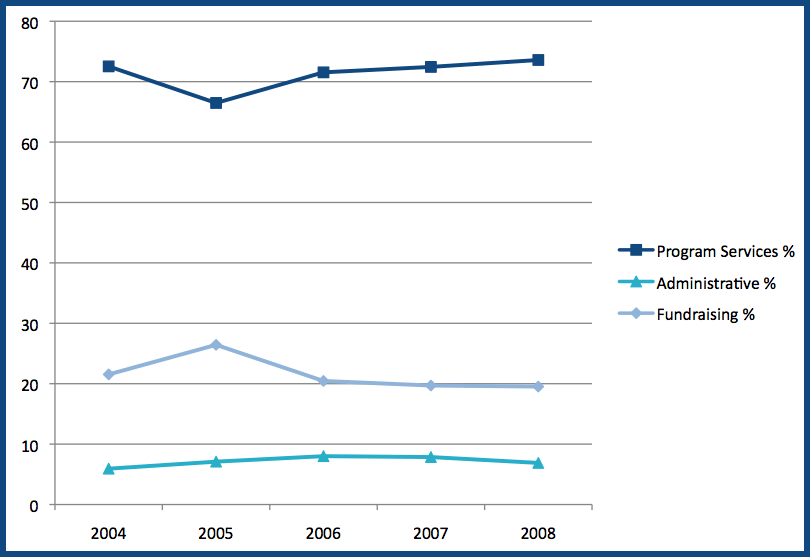
That blip in 2005 showed they cut services to increase fundraising. This is rather interesting if you look back at a graph I already posted that showed their revenues for the same time.
See that bid drop off for 2005? That means that increasing the percentage of their expenses on fundraising didn’t actually stop the plunge in revenue. Regardless of the fact that fundraising surged to more than 25% of their expenses, their revenues dropped by more than 20%. Even though their revenues continued to fall, never by so much as 2005. That tells me they get more for their dollar by investing in programs rather than direct fundraising costs. Some other groups could learn a thing or two about that concept.
West Virginia Guv Vetos NRA Bills

Governor Manchin of West Virginia has vetoed two NRA backed bills. I have to give him credit, at least for principled opposition on the bills. The one, which was a tax free holiday on guns, he’s opposed to because it would undermine revenue for the state at a time when the state was struggling to make ends meet. As a person who’s fairly neutral on these tax holidays for guns, this doesn’t particularly dismay me. The other bill the Governor vetoed is the Bloomberg Bill, which would have make his “stings” illegal, and his opposition to this is far more interesting:

“I am in full support of this legislation,” Manchin said of SB515, “However, I must veto the bill for technical reasons. There is a faulty cross-reference in the bill that would purportedly penalize violations of an unrelated code section.”

I’m not one to trust a politician at his word, but sure enough, you go into the bill and you have a drafting error:

(5) A person who knowingly solicits, persuades, encourages or entices a licensed dealer or private seller of firearms or ammunition to transfer a firearm or ammunition under circumstances which the person knows would violate the laws of this state or the United States is guilty of a felony. A person who willfully procures another to engage in conduct prohibited by this subsection shall be punished as a principal. This subsection does not apply to a law-enforcement officer acting in his or her official capacity. Any person who violates the provisions of section five of subsection (5) of this section is guilty of a felony, and upon conviction thereof, shall be fined not more than $5,000, imprisoned in a state correctional facility for a definite term of not less than one year nor more than five years, or both fined and imprisoned.

Emphasis mine. Section five is relating to revocation of permits, and it’s not part of any subsection. In fact, it’s not really possible to have a section of a subsection, and section 5 doesn’t have a subsection 5 regardless. This is completely nonsensical if you look at the layout of West Virginia’s statutes. I’m not sure I agree with the Governor that it criminalizes an unintended section, but it’s definitely wrong and needs to be fixed. It can easily be fixed by replacing the bolded portions with “this subsection.”  Hard to believe this made it all the way to the Governor without anyone noticing.

Who’s Driving the Shooting Business

Michael Bane notes that it looks like shooters and self-defense oriented gun owners are in the drivers seat when it comes to the industry. He notes:

Note that hunting came in 4th on that list. It wasn’t that long ago that our trade organization said that the future of gun rights in America was “irrevocably” linked to hunting, and their massive survey of a couple of years back (which I had the temerity to question) delivered the same warmed-over crap and, unfortunately, sent the industry haring down the same dead-end paths.

We’ll be talking about this more on the podcast next week…

I think I remember the report Michael is talking about, and he was right in questioning it. Our reaction to the report was here, and Bitter’s was here, over at her now cooking blog, but then gun blog.

Will Guns be an Issue in the 2010 Elections?

There’s not a lot happening at the national level in the political sphere of our issue. Yes, we’re waiting on McDonald & Stevens, but those aren’t things we can control directly at the ballot box. (Though with Obama likely to get 2 or more SCOTUS appointments, pay close attention to your Senate candidates.) With so much uncertainty in the economy, it seems hard to imagine that guns will play a significant factor in 2010.

So imagine my surprise when the Second Amendment is getting some play out in Pennsylvania’s 12th district – the race to replace the late John Murtha. It’s been tweeted and is now appearing in commercials. Both candidates in the special election discuss it on their website. Our issue has not gone away, and politicians are still rushing to embrace gun owners in many areas. What can I say, other than it’s nice to be winning.

Online Chatter About Repeal

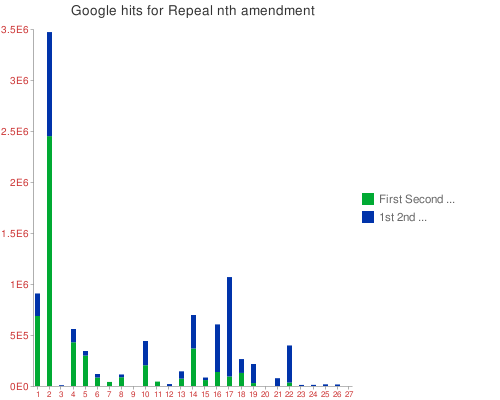
It would seem that someone is doing a lot of chattering about repealing the Second Amendment. Whether it comes from folks on our side talking about those who want to do it or from folks on the other side who want to do it, it sure tops out all of the other amendments.

At least it looks like Amendments 9, 20, and 27 are safe.

Cross-posted from PAGunRights.com.

The Overall Health of the Brady Campaign

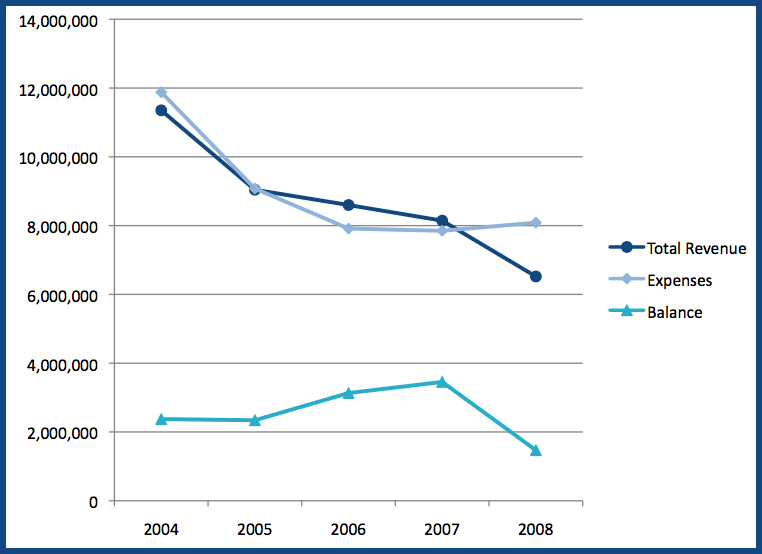
Again, by reader request, I reworked the numbers a bit. beatbox made a good point that combining the total donations and expenses of both the Brady Campaign and Brady Center would give us a better picture of the organization’s overall health. I would agree in very broad terms.*

As you can see, 2008 is really the outlier when you look at the combined revenue/expense model. That shouldn’t be shocking because of not only the recession, but the Heller loss early in the year before most donations arrive. There is definitely a downward trend, but their combined “cushions” didn’t really take a major hit until 2008.

*It was still handy to break down the individual data because that tells us if they are heading for a re-alignment and/or shifting their strategy. At some point, they will need to reorganize and probably rename themselves again. Consider that the main event they use to tug at heartstrings happened just two months after I was born – and I’m approaching the age where women start lying about their age. There’s no context or meaning to it anymore for a good number of Americans. With the courts as the new major battleground for the next few decades, it just makes sense for them to shift their limited resources to litigation and related support services. These are the changes we will see in the organization breakdown featured in the first post on the subject.

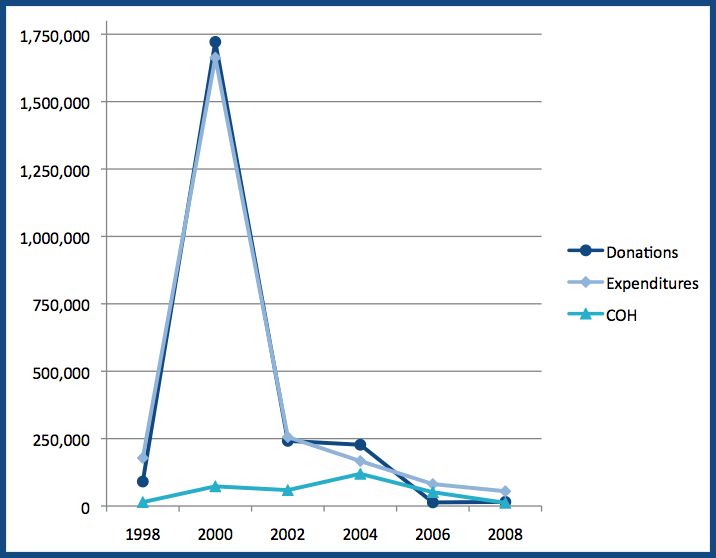
Looking Back a Bit Further

In the last post, beatbox mentioned the Brady campaign finance data for their PAC arm and how much it has been hurting in recent years. I didn’t include that information in the initial look at the Brady finances because without diving into tons of very convoluted campaign finance reports, it’s a pain in the ass to break out by individual year as opposed to election cycle. And really, a year-by-year breakdown won’t give you any more insight that’s worth looking at. I wanted to keep the data sets in one post the same, or in the case of this post, similar.

Joe Huffman also piped up that he had some older 990s from the Brady camp, though it turns out they are only for the Center. Hugely useful data going back to 1999 (technically 1997, but missing 1998, so I’ll start out in 1999) for the Center, and he deserves a huge kudos for putting that together. But, because the Campaign appears to have been their core source of income until 2008, I don’t want to skew the data by updating only the Center’s numbers in the last post.

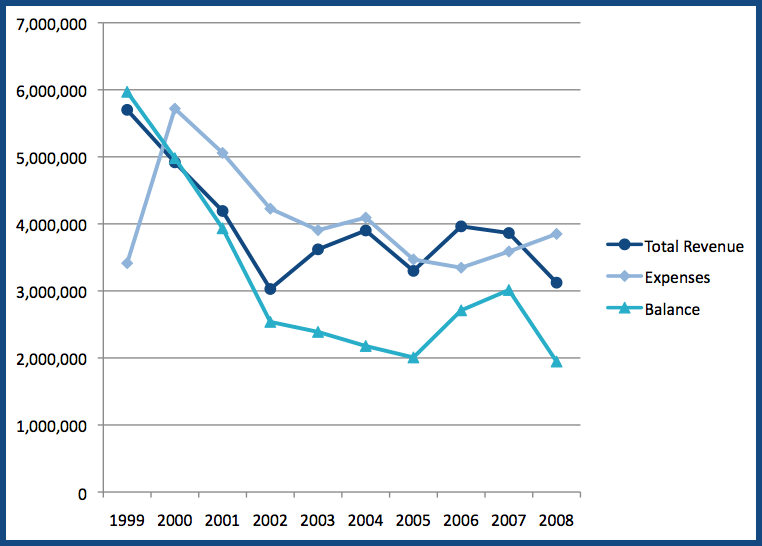
So what do the prior two paragraphs mean? Just that here is the data for the Brady PAC donation/expenditures/cash on hand for 1997-2008 (the 1998-2008 cycles) and the Brady Center revenue/expenses/ending assets for 1999-2008. (The ending asset is what I previously described as their cushion or nest egg, essentially savings they can dip into when they spend too much.)

Remember, these are similar time periods, not perfect matches. The PAC cycle includes two years that the Center graph does not.

For those of you keeping score at home, this shows that the “cushion” they could dip into when major legal threats come up has fallen by more than 67% since 1999.

Some Iowa Sheriffs “Just Know”

This here is exactly why we’re against wide discretion:

Based on their experience and contacts, sheriffs sometimes “just know” without written documentation that a person can’t be trusted with a carry permit, Gardner said.

No, you don’t just know. When someone comes in the door to hand you an application, you don’t know him from Adam. Talking to someone for a brief period isn’t like to be more revealing. If you can’t articulate the reasons a permit should be denied, you should issue. That’s how it works for most Iowa counties, and how it works in most states in this country.