
Apparently none of the shot timer apps for iPhone will work with the iPhone 4s noise canceling microphone. I guess it works if it can silence gunfire. Sounds like Apple should put an API in to disable noise cancellation, assuming it’s not built directly into the hardware.
Category: Guns
Quote of the Day
From Dave Kopel over a Volokh:
Civil liberties organizations which tie themselves exclusively to one party put liberty at risk. In a two-party system, it is inevitable that each party will dominate some of the time. Civil liberties are safer in the long run when they have friends in both parties, and when those friends know that civil liberty organizations will reciprocrate their support,especially during tough elections.
Yes. The only reason we’ve been safe in this Congress is because we’ve accomplished making the Second Amendment a bipartisan issue.
Heart Not In It?
Looks like Ray Schoenke must have tired of his strategy of trying to build an organization to help give anti-gun Democrats pro-gun cover. Because it looks like he forgot to pay AHSA’s hosting bill.
WaPo Covers NRA Endorsements
Friendly coverage from the Washington Post. Â Maybe the way to get the MSM on our side is to be seen as helping their Democratic friends in Washington. No doubt the Bradys aren’t going to be pleased to see this article this morning.
Threat from the ABA
Howard Nemerov is noting that the American Bar Association is now promoting micro stamping, and unlike the Bradys, they bring a lot of money to the table to help push for it.
Ask And You Shall Receive: Murder Rates
Someone e-mailed today and mentioned the following:
Strictly speaking, the Bradys don’t argue that gun control will lower violent crime, they argue that it will lower the rate of violent deaths by decreasing the effectiveness of the violent criminals (and by making suicide attempts less successful).Do you have any data on how rates of gun ownership correlate to murder rates (or even to violent death rates including all suicides)?
That much is true. I have heard gun control advocates claim this. I don’t have suicide data readily handy (if someone knows a source, I can plug it into my spread sheet). I also suspect suicide will correlate some, because suicide by gun is more effective, and an option many will pick if it’s available. That’s why they use “gun death.” Â I just don’t think taking away dangerous things from people because they might hurt themselves with it is proper public policy for a free society, statistics be damned. But here’s the murder charts:
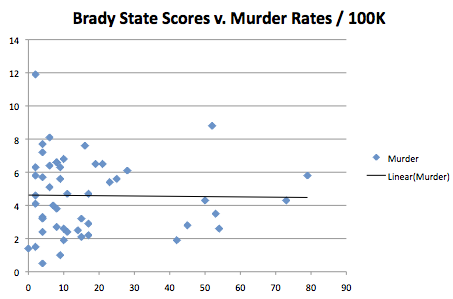
Statistically there’s no correlation here. Plotting along X are the Brady scores, and along the Y is the murder rate per 100,000 population of that state. Also, if you look at gun ownership levels versus the murder rate, you get something similarly uncorrelated:
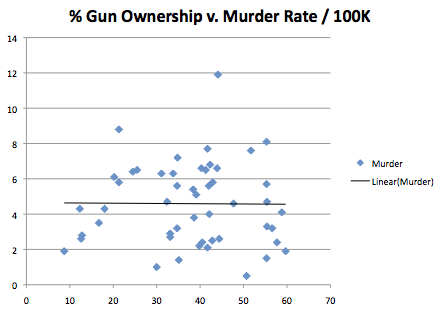
Here we also have no correlation. We have percentage of gun ownership as X, and murder rate per 100,000 as Y. Compared to gun ownership, murder rate is random noise. So what does the murder rate correlate to? I actually did run all these numbers, but did not include them in the original post, because it was rather long. Murder correlates weakly to poverty indicators, as does violent crime. It’s uncorrelated with urban density, though Brady score is strongly correlated with urban density. I was surprised that urban density does not correlate with violent crime or murder. Not surprised urban density plays a role in how much gun control a state has.
The essential thesis stands. Gun control does not accomplish what it’s advocated to do. The typical retort from gun control advocates to statistics like these is “Well, gun control in this country has never been tried.” That might be true, but to the extent it has been tried, it’s failed. Given the constitutional and political realities present in this country, it’s an academic argument anyway. The types of gun controls promoted by the Brady Campaign do not work, unless they want to offer their own statistical model that shows it does.
Debunking MAIG’s Latest Study
By now everyone has seen MAIG’s latest study that I said seemed to jump to conclusions. Not wanting the other side to have a monopoly on drawing conclusion based on data, I’ve been looking more closely at the data in my <sarcasm>copious free time</sarcasm>, and compiling this post. I am by no means a statistical expert, and I hope that someone like Power of Epsilon Blog can look this over and tell me if it looks reasonable. A large percentage of the MAIG study seems to hinge on 2009 Interstate Export Ranking, which is based on traces per capita, in this case the number of guns traced back to a state per 100,000 people in that state. The first thing I decided to do is use the Brady score as a proxy for how many MAIG-approved gun control laws a state has passed. Since MAIG and Brady have the same agenda, this would seem reasonable. There is a slight correlation, but it’s not remarkably strong:
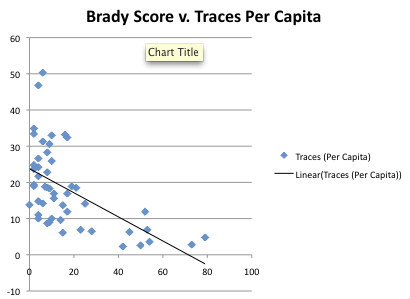
These look inversely correlated, which would would no doubt please the Brady folks, but the set has a correlation of -0.56, which for a sample size of 50, isn’t all that remarkably strong. So I set out to find out which data the trace per 100,000 data does correlate strongly with, to see if we can find an explanation.
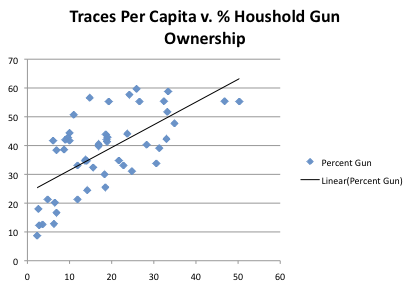
Here we have traces per 100,000 persons on the X-axis, compared to household gun ownership on the Y-axis. Now that’s a better correlation, with an Pearson r value of 0.65, which is strong. This makes sense. States with a higher household gun ownership have more guns to later be traced by ATF. MAIG’s statistic could be just as easily explained by the fact that states with high rates of gun ownership have more guns stolen than states with low rates of gun ownership, and that states with low rates of gun ownership necessarily have fewer legal channels for purchasing guns. States with fewer gun owners have fewer legal sources for guns to be traced back to. It’s hardly surprising this correlates more strongly than law.
But to me, this isn’t where the rubber truly meets the road. Any promotion of gun control s public policy ultimately has to face off with Joe’s question. It’s here that MAIG’s research falls apart.
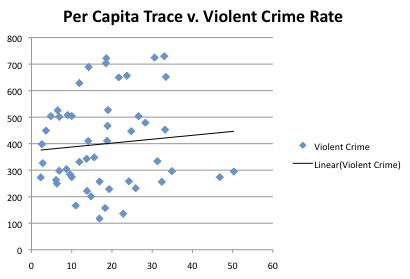
Despite the very slight upward trend line, the correlation here is 0.09, which for a sample size of fifty is essentially uncorrelated. Even if you were to assume that the states which are exporting guns are exporting violence, this doesn’t seem to be the case, since that would result in a negative correlation. If you were to assume that states with high rates of gun ownership, and thus high traces, were more violent, you would also be wrong. In fact, here’s the graph of the correlation between household gun ownership percentages and violent crime:
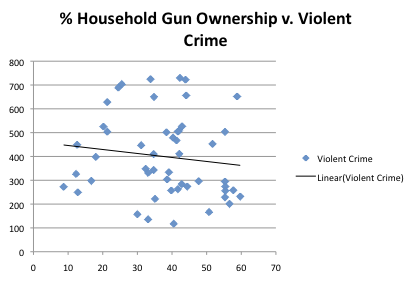
The general trend line is slightly dropping as gun ownership increases along the x-axis, but the correlation here is -0.13 which for a sample size this small is essentially uncorrelated. Note that I’m counting violent crime as a whole, not just “gun violence” and not “gun deaths” (counting suicides) as our opponents like to do. It does most people little comfort if they are stabbed to death, as opposed to being shot. Getting your head bashed by a baseball bat is likewise unpleasant. Overall rates of violent crime are all the really matter.
Interestingly enough, one of the strongest correlations I came across was the correlation to Brady Score and levels of household gun ownership in that state, which had a Pearson’s r value of -0.73, meaning the higher the Brady score goes, the lower household gun ownership becomes, and that the Brady Score is a reasonable predictor of levels of gun ownership in a given state. But the Bradys can’t argue their score is a predictor for violent crime, as the correlation between Brady Score and violent crime in a given state is 0.02, which is uncorrelated.
A possible conclusion that could be drawn is that all the Brady agenda accomplishes is driving down overall levels of gun ownership, while having no discernible effect on violent crime. This would lend support to the theory that gun control only disarms the law abiding. One wonders how anyone can support an agenda that does not accomplish its claimed goal, but I would argue that driving down overall levels of gun ownership is exactly what our opponents mean to accomplish. Gun control has never been about combating crime, but about combating gun ownership itself. This article from the Untied Kingdom is no better example of this. In this sense, gun control has been a rousing success where it’s been tried, it’s just a shame it does nothing to lower violent crime.
Castle Doctrine Finally Overcomes Opposition
We’re not done yet, but Castle Doctrine has finally come through the House. The vote was earlier this evening, and involved lots of yelling, many threats, and even some cane waving. There was some of the most entertaining sausage making I’ve ever seen. I wished I had recorded it for future laughs.
The bill faced several hurdles, including an attempt to adjourn instead of actually holding a vote. The Philadelphia Democrats tried out-of-order motions to table the bill, even when the Speaker repeatedly announced the call for a vote on the actual bill.
At least one AP reporter “gets it” with this summary of what’s going on:
The vote to widen the “castle doctrine” so that it applies beyond homes and vehicles was 159-38, with dozens of Democrats voting with Republicans, the latest demonstration of how gun issues do not follow partisan political lines in the Pennsylvania Legislature.
It’s so refreshing knowing to see a reporter acknowledge that the important issues doesn’t break along party lines. The article also reports that a Senate Republican source says the Senate will, in fact, take up the bill next week. Gov. Rendell still won’t say whether he will veto or sign.
Having Lost on “Keep” …
… the Brady Center is doing all it can not to lose on that whole “bear” part. Unfortunately, there’s language in Heller that could go either way, but at minimum, the Court strongly hinted that California would have to allow some form of carry, even if it’s open carry, of a gun that’s ready for self-defense (loaded, in other words).
Once Again, With Energy, the “R” is for Rifle
Red State is getting their panties in a bunch again because the “R” in NRA doesn’t stand for “Republican.” It’s no secret that NRA is endorsing many pro-gun Democrats. NRA seems to have gone out of their way this year, on the PVF web site, to explain their endorsements, especially for Democratic candidates. Obviously Red State is pushing GOA as an alternative, because GOA has never met a Democrat who is pro-gun enough for them. Does GOA want to explain why a solid pro-gun guy like Dan Boren (Democrat) has an A- while the rest of the (Republican) Oklahoma delegation gets solid As? Where did Dan go wrong? Do they want to explain why Markey, despite a solid voting record on our issue this Congress, is getting a D?  How do they justify a low grade of C for solidly pro-gun Jason Altmire? Or the same grade for Chet Edwards in Texas.
I maintain that GOA’s grades are a shameful scam on the American gun owner, as is their entire organization. NRA is coming around to being more transparent about their grading system. To the extent that NRAÂ can be transparent (and they are limited with how much they can be because of political considerations), that’s a good thing. Where is GOA’s transparency? Why is it, seemingly, that Democrats can’t be pro-gun enough for them?