
We’re Very Tolerant People

As I’ve mentioned before, Daryl Metcalfe is a great supporter of the Second Amendment. But he’s also, we believe, a bit off his rocker. First the a house resolution on domestic violence turns into part of the gay conspiracy. Then soliders who exercise their rights as citizens are traitors? Not wanting to give anyone the impression that Rep. Metcalfe might be coming back into the mainstream of Pennsylvania politics, now he’s finding the gay agenda in teaching high schoolers about dating violence:

Specifically, they wanted dating relationships defined as relations between heterosexual couples. Right now, the bill — reflecting the real world that kids actually live in — makes no distinction as to gender.

During floor debate, Metcalfe warned his colleagues — and we swear we’re not making this up — that “a rogue teacher could introduce homosexual relationships into the conversation. And a lot of students could be offended.”

Rep. Metcalfe is curiously concerned about the gay agenda above and beyond your average citizen. While I know that many gun owners are socially conservative, as a lot we’re very tolerant people. For instance, Larry Craig still managed to get approved by the NRA Board Nominating Committee despite his wide stance. I think Rep. Metcalfe would do better to focus on restoring fiscal sanity to Pennsylvania, and continuing to protect the liberties of residents of this Commonwealth, whether they are gay, straight, or otherwise. Give up the witch hunt. That crap is killing the Republican brand with younger voters, and it’s time to move on. This country and State have far bigger problems than this.
You Have to Hold Individual Politicians Accountable

Jim Geraghty makes some excellent points about the dynamic between parties when it comes to gun rights:

But there’s a catch. For even the best, most pro-Second Amendment House Democrat, the first vote they cast in the House is to make Nancy Pelosi the Speaker of the House, ensuring the floor schedule is controlled by a woman who is scored an “F” by the organization. And her speakership ensures that F-rated John Conyers of Michigan chairs the Judiciary Committee, and that liberals, often but not always anti-gun, control the important committees.

Meanwhile, if that A-rated House Democrat were beaten by some squishy C or B-rated Republican, his first vote be would make A-rated John Boehner (or perhaps some other Republican) the Speaker.

It’s a very good point, but I’m not sure how you really get around it unless you score the vote on the Speaker and leadership. We don’t want to hitch the gun rights wagon to a particular party, but we do want to hold individual politicians accountable for their positions on our issue, and many Democrats on the issue are quite good. If we refuse to back Democrats who support our issue, we essentially offer the Democrats nothing for their support, in which case, right now, we’d be getting steamrollered in Congress.

So why not score the vote on the Speaker? Because, not surprisingly, politicians are political animals. If the Republicans and pro-gun Democrats can get together to get together and form a majority for the purposes of gun bills, they can’t necessarily get together on other matters, such as the selection of Speaker. The problem is, while the Democratic Party is divided between Progressives and moderate-to-conservative Blue Dogs, the Progressives are the ones in the safest districts, and the ones with the most seniority.

They also represent a voting majority within the party itself. The only way you could get a different Speaker than Pelosi would be if the Republicans and Blue Dog Democrats got together and elected a different Speaker. That’s not going to happen. Why? Because the party is in charge of committee assignments according to House rules, and any Democrat crossing the ailes for that kind of thing is going to find himself with the worst assignments. There’s also many many things the party apparatus can do to a Blue Dog to make him cooperate, or punish him for lack of cooperation. The system makes it very difficult for a minority faction within a party to have a whole lot of sway, so it’s very difficult for them to buck their party on a vote like Speaker. Sure, you can grade the vote, but it’s not going to make you popular on the Hill, and you’re not going to win anyway. There’s no easy answer to the Pelosi problem.

What surprises me, is that in a year like this one, you don’t see more Blue Dogs threatening to switch parties if the progressive leadership keeps twisting their arms. Maybe there’s a good reason that move is very hard to pull off in DC, but if I were in their shoes, I wouldn’t hesitate to play that card. This is going to be a bad year to be a Democratic. Even worse if you voted for the health care bill.

The Threat That Isn’t

Obama says he’ll withdraw his support of wavering Democrats on Health Care, and not campaign for them. It would seem to me that this isn’t exactly a threat. In fact, if I were one of those wavering Blue Dogs, I think my inclination would be to ask the White House if they would put it in writing. Perhaps Obama could twist more arms by threatening to show up at key campaign events. You can’t say “no” to the President, after all.

Henigan Misrepresenting Concern

Dennis Hennigan of the Brady Center is misrepresenting Barr and Gottlieb’s, and by proxy all concerns about open carry:

Implicitly, Barr and Gottlieb are advising gun owners who want to carry guns in public to keep them concealed from view; that is, make sure the danger is hidden. Perhaps this exposes their real concern about the open carry movement – that it eventually will cause a surge in public concern about the far more prevalent concealed carrying of guns made possible by the gun lobby-supported “shall-issue” laws passed in most states during the last two decades making it far easier to obtain licenses to carry concealed weapons. They also likely fear that open carry may intensify public opposition to recent efforts to gradually expand the locations in which concealed carry may occur -such as parks, bars, college campuses, even airports. After all, it’s not the “openness” of open carry that scares people – it’s the presence of the guns themselves and the inherent danger they entail. The only reason there is not an equivalent reaction to concealed carry is that the danger is, by definition, hidden from view.

He seems to believe that Barr and Gottlieb are somehow tacitly acknowledging the danger. There is no significant public danger from the open carry movement. The “danger” is the Brady Campaign doing exactly what they are doing now: trying to use the issue to push their agenda and to divide our movement.

Concealed carry laws don’t exactly have low levels of support. Even in Iowa, the latest battleground for concealed carry reform, opposition doesn’t beat 50%. But what Dennis understands is that public policy isn’t made by poll, but by determined minorities. If the 43% of Iowans that want to reform the concealed carry laws are motivated to do so, while the opposition is passive, reform wins. What they are looking for is getting some of that passive opposition to turn active.

The concern Gottlieb and Barr have is not that the public will suddenly realize the danger, and the gig will be up. The concern is that, much like the public is willing to acquiesce or support equal rights for homosexuals, they might not be so keen on the idea if they believe that means they’ll see gay sex everywhere in public. The analogy to guns may not be perfect, but many people who generally don’t care about or are soft supporters of people being able to carry firearms for self-defense might have a second thought if that means they think society will turned into an armed camp.

That shouldn’t really be our goal. Our goal should be that people who want to or need to carry a firearm for self-defense be able to do so, following their own judgments about their individual circumstances and situation. Whether that right is exercised through open carry or concealed carry I could care less about. What I do care about, however, are activism methods that have the potential to create a public backlash. The fact that the Brady folks have suddenly jumped on this issue, after its been gaining traction for years, makes me wonder if someone on their side of the issue has paid for a focus group, and we’re now seeing Brady attempt to exploit the opportunity.

Popular Constitutionalism

From Sanford Levinson, Professor of Law of the University of Texas, on interpreting the Constitution:

“It really is open to interpretation by anybody, in what I sometimes call the lawyerhood of all citizens. Anybody in a bar can get into a shouting argument over what equal protection means, or the right to free speech.”

He must hang out in very different bars than the ones I’ve known, but the assertion is interesting. The article goes on to say:

Those arguments can and should have consequences, according to scholars who endorse what they call “popular constitutionalism.” “Basically, it’s the idea that final authority to control the interpretation and implementation of constitutional law resides at all times in the community in an active sense,” Larry D. Kramer, the dean of Stanford Law School, wrote in The Valparaiso University Law Review in 2006.

This is versus originalism, which essentially argues the meaning of the constitution doesn’t change over time, and its meaning is divined either through original public meaning or original intent (of the founders). I’m probably a bit more of a pragmatic originalist. I think you have to be rooted in the text of the document, and when its meaning is apparent and has a clear meaning, you interpret along textual lines. But I also tend to agree with Jefferson, who once wrote:

The idea that institutions established for the use of the nation cannot be touched nor modified even to make them answer their end because of rights gratuitously supposed in those employed to manage them in trust for the public, may perhaps be a salutary provision against the abuses of a monarch but is most absurd against the nation itself. Yet our lawyers and priests generally inculcate this doctrine and suppose that preceding generations held the earth more freely than we do, had a right to impose laws on us unalterable by ourselves, and that we in like manner can make laws and impose burdens on future generations which they will have no right to alter; in fine, that the earth belongs to the dead and not the living.

My big problem with doctrinaire originalism is precisely what Jefferson speaks of here, of previous generations imposing their “burdens on future generations.” So when Alan Gura, in the the oral arguments of McDonald says the court should be originalists in its identification of a right, but take a modern view of that right, I can relate to what he’s saying.

How much of a role should originalism play in constitutional interpretation versus such a “Popular Constitutionalism” method? Keep in mind you will generally arrive at an individualist Second Amendment either way. But originalism and popular constitutionalism probably yield different results when it comes to interpreting the boundaries of that right. The founders’ concern, which prompted the inclusion of the Second Amendment, had very much to do with the distribution of military power in society and keeping military power be in the hands of the people. It’s not that they didn’t believe in individual self-defense, but that wasn’t the primary intent. From the founding up to the civil war, the public understanding became centered around individual self-defense. This is largely the popular understanding today, and what The Court went with in Heller. It’s always seemed to me that original public meaning originalism (as supposed to original intent) is actually a form of popular constitutionalism, though one that looks back at the meaning at the time the text was adopted, instead of how people view it today. A Second Amendment right centered on the original intent distribution of military power probably looks very different from one centered on self-defense in an original public meaning context, which looks different yet from one in a modern popular constitutionalism context.

I’m not sure that any method has to necessarily disparage the other when it comes to the right to bear arms, but which one is most legitimate? Which one is most rooted in the real world? Which one best preserves liberty?

Now I Know Why Obama Loves Philly

I don’t know if y’all have noticed, but Obama really enjoys coming to the Philadelphia area. He’s here often enough that when Sebastian complains about all the cops out when he drives to or from work, we can safely assume that Obama is here.

I think I just figured out why that is. It’s not because the City of Brotherly Love is showed him so much love in the last election (in the form of men armed with batons blocking polling places). It’s because the stench of Democratic corruption must remind him of Chicago.

For those who have forgotten, Obama won his first campaign unopposed. Which is interesting considering there was a sitting Democratic incumbent who did not retire. He challenged all of her signatures to get her thrown off the ballot – along with any other competitors.

The intriguing campaign I mentioned yesterday is facing a similar problem. Only instead of her being an incumbent, she’s a political newbie who has no shot of winning the overwhelmingly Democratic district represented by the head of the Philadelphia Democratic Party. But he wants her off the ballot anyway. There’s no room for anyone else once you factor in his ego, I suppose.

More on the Constitutionality of the Slaughter Solution

There’s been some more activity today on the issue of whether the Slaughter Rule for passing Health Care would be constitutional.  Michael McConnell says it’s not constitutional in an op-ed in the Wall Street Journal, via Jonathan Adler of the Volokh Conspiracy. Based on this reading, which would indicate the House and Senate never actually plan to pass the same bill, I would agree it’s unconstitutional. I would think there has to be limits to House and Senate rules in so far as they aren’t delegating their role to the other body. For instance, if they create a rule that deems two bills to be passed with one vote, why not three? Four? Twelve? Certainly they can consolidate twelve bills into one bill, but can the House or Senate really have a rule that just deems any number of bills as “passed” even if there’s never been a vote? I think the answer to that has to be no, at least if the Constitutional role each body plays isn’t considered to be unconstitutionally delegated.

Pentagon Shooter’s Gun Has a Long History

The Washington Post is doing a bang up job of trying to push the idea of banning private sales of handguns. I think there’s a solution to this kind of problem, but it’s not liable to please the gun control groups. We could have background checks for private transfers, without banning them. But it would require a lot of changes to the current system to deal with our concerns, including opening the system up for everyone to use, full transparency, and anonymized transactions. I don’t see any of the anti-gun groups agreeing to negotiate from that as a starting point. Come to think of it, I don’t see the government agreeing to that level of transparency either.

An Intriguing Campaign

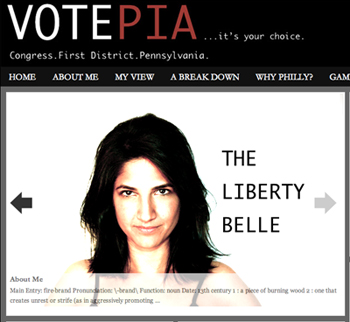
While researching my list of federal candidates on social media sites, I came across a longshot campaign for Congress against Rep. Bob Brady in Philly. Brady heads the Philadelphia Democratic machine. At the big Democratic shindig/nominating party, he was right up on stage with Nancy Pelosi – the only non-statewide office holder or candidate I saw up there with her. The head of Pittsburgh’s Democratic Party wasn’t around, just Philly. I don’t think the dead girl/live boy rule even applies to this former union organizer.

But this 27-year-old girl not only has a great website, she has a message that could disconnect some of the younger voters from the entrenched Philly politicians. (That won’t win races, but it’s just interesting.) Here’s what I like:

  • Focusing on where the incumbent leadership has failed: “Today, the First District has the distinction of being the second hungriest district in the nation. It has some of the worst schools, the highest crimes rates, the most strangling taxes and the greatest pension problems. For too many years, this district has been abused by those who have ravaged this birthplace of the American dream under the guise of brotherly love.”
  • Specific example of broken promises/wasted resources that tangibly makes district life worse: “In an attempt to revitalize the city by bringing a green real estate project to the district (without grants or government aid), I came head to head with the inner politics that go on here every day behind the scenes. The Industrial Empowerment Zone, a nation-wide government program started by President Clinton, was meant to bring industry back to Philadelphia but we know industry is not coming back. Philadelphia has been given millions of dollars in federal funds to essentially blight neighborhoods causing homeowners and landlords to drastically lose property value. These properties are being purchased by well connected insiders at bargain-basement prices at the expense of the residents of the First District. Our project was rejected by the zoning board the day after Michael Nutter promised to make Philadelphia the greenest city in the nation in his inaugural address. Today, the land still sits vacant.”
  • Confidence in style. Take a look at her website. She at least knows how to make you to stop and take a look.
  • According to her site, she wants to use this opportunity to create a PR plan for free markets that others can use around the country. I like the attitude of experimentation here. It’s beyond an uphill battle, but sometimes those are the best opportunities to try radical ideas to see if anything sticks. It may not win this race, but maybe something useful will come out of it.
  • I think her campaign video has a few issues, the first of which is a little too hard hitting for most voters who aren’t that comfortable taking a leap to something new in rough times. But, I do think it’s a great example for others to follow in support of candidates to specific constituencies (i.e. rallying the base). I love the ending – a real call to action to not let them get away with this anymore. It’s not enough to bitch, action has to be taken.
  • Contrast her message with Bob Brady’s campaign site which is nothing but why you should give him money and how you should give him money. He’s not interested in telling you about himself or really giving a damn about what you want to hear.

I have no illusions about how this campaign will turn out in November. But sometimes losing can teach us lessons about how to approach other battles. What I like about her web presence isn’t so much a “sexy/MTV” vibe, but how real issues are addressed and not just talking points. Even when she does rely on talking points, she remembers to put in the request for you the viewer to help take back the country and make it a better place.

I can respect those who actually take a stand to try something new. It is the spirit of America, and I hope that Pia does find a few elements that stick, even in solid blue Philadelphia.

More Election Stats

Why? Because I’m fascinated by this stuff.  And I spent two days studying district maps, Googling unknown candidates, and otherwise trying to find every bit of information on these elections that I could in order to make a more useful resource for gun owners this year.

  • Of the 6 Senate races in the area, 4 incumbents were A rated in their last election cycle. One was a B rating, and the other F.
  • There are 30 House races in the area. Only 8 of these races are (so far) uncontested. Six of those are districts in Philadelphia.
  • Of the 8 unchallenged incumbents, 2 had Fs, 2 had Ds, 1 had a C, 1 had a B, and 2 have maintained A ratings.
  • Looking at the full list of races with incumbents running (28), we have: 3 ?s, 3 Fs, 10 Ds, 3 Cs, 4 Bs, and 5 As.
  • The two open seats were previously represented by lawmakers with A and F ratings.

I think our pro-gun Senate seats are safer than the pro-gun House seats on the whole. One of our B rated guys in Philadelphia is actually facing charges, though to be honest, that doesn’t turn many Philly voters off. So I maintain that even though he has challengers from his own party and the other, it might not be much of a race for the new entrants to the race.

The House races are especially important for those who fall on the right side of the political aisle. Right now the Democrats control the House by just a handful of seats. The Senate is safely Republican, and is likely to become even more so after this year’s elections. This will be legislature that redraws all of the district lines and erases at least one Congressional district from the state.