Figuring Out the NRA Ballot

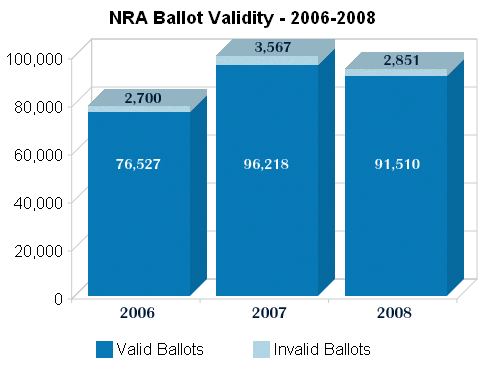
There is always some confusion about the NRA ballot.  There are so many seats – many more than most people are used to in any organization – and the Nominating Committee supports more candidates than seats.  But what happens when people get it wrong?  Easy, their ballot is considered to be invalid.  The folks who scan the ballots don’t aim to be Florida election officials, so they tend not to try and determine the proverbial hanging chads.

nrainvalidballots06-08I will confess  that one of my favorite times of the NRA Annual Meeting is when Jim Land gets up to read the election results.  Included in that report is a summary of how many invalid ballots they received, as well as the reasons why various ballots were declared invalid.  I find it quite amusing.

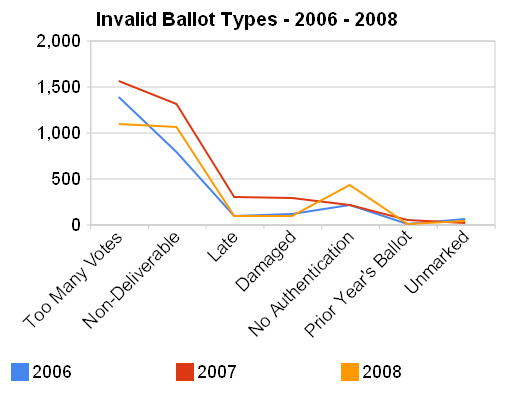
nrainvalidballottypes06-08I realize that lines may make this chart a little confusing.  However, they were easier to follow year-to-year than just plain dots.

Yes, as you can see, there are between 10 and 50 people who, for the last three years, have saved a ballot from a previous year and submitted that one.  That’s impressive.  It’s one thing if they just hold on to a copy of the old magazine, but to actually take the time to send in the ballot during the voting period the next year, that’s just crazy.

The most common problem is clearly too many votes.  This year, you may vote for up to 26.  However, if you don’t have 26 people that you’re just dying to vote for, then it is advised you limit your votes.  So-called bullet voting helps your favorite candidates more than spreading out votes across the entire ballot.

Kopel Urges Gillibrand to Stick to Her Guns

Dave Kopel has an excellent article in the National Review that’s well worth reading, offering Senator Gillibrand some very smart political reasoning for sticking to her position on gun rights:

Thanks to the New York media, if there’s one thing that New York voters know about Kirsten Gillibrand, it’s that she’s pro-gun. For most of those voters, the gun issue is not a top priority one way or the other; New York has elected quite a few pro-gun candidates, including Ronald Reagan twice, Sen. Al D’Amato three times, Sen. James Buckley once, and Gov. George Pataki, who ran as a pro-gun candidate and unseated Mario Cuomo in 1994, three times.

Read the whole thing.  Hopefully, she’ll listen.

Utah Gun Shop Suit Proceeding

Looks like the lawsuit against a gun shop which sold the shotgun to the Trolly Square shooter is proceeding.  Seems it was a pistol grip shotgun, which is a pistol, which means you have to be 21 to buy one from a dealer.  The Trolly Square shooter was 18.  Remember all the noise they made about PLCAA preventing lawsuits against dealers who sold guns illegally?   Another bit of hysteria that turns out to have been untrue.

UPDATE: And in the commentary, we have yet some more confusion between gun owners about whether a pistol grip shotgun is a shotgun or a pistol.  If you shorten it, is it an SBS, or AOW?  I think it’s an AOW right?  Might depend on whether it ever had a shoulder stock.  I think.  Not entirely sure.  And the Bradys would like to tell us this industry isn’t regulated enough.

Inquirer Story on NJ Gun Rationing

The Inquirer is naming names on the One-Gun-A-Month bill being pulled in the New Jersey Senate:

But the plan received only 20 of the 21 “yes” votes yesterday needed for approval. Every Democrat supported the plan except for Senate Majority Leader Stephen Sweeney and State Sen. Fred Madden, both of Gloucester County, and State Sen. Jeff Van Drew (D., Cape May). Every Republican voted no, except for State Sens. Phil Haines (R., Burlington) and Jennifer Beck (R., Monmouth), who abstained.

It’s critical that New Jersey gun owners call the offices of the representatives listed who voted no on this and thank them.  New Jersey Republicans are showing an unusual discipline on this issue, and they deserve some praise for it as well.  Call the two abstainers too, and tell them you would like them to vote no.

Oh, and be sure to tell them you saw the article in the Inquirer that said they voted no.  No doubt Bryan Miller’s friends at the bankrupt Philadelphia Inquirer are hoping to generate the opposite response.  Let us stick it to them!

One-Gun-a-Month Pulled in New Jersey

Gun rationing was up in New Jersey today, as we mentioned last week.  The bill was pulled by its supporters at the last minute in order to, once again, avert defeat.  See, if the legislature has a floor vote, and the measure is defeated, that bill is dead.  It has to be reintroduced, and the process started anew.   By pulling it from the agenda, it’s still alive, and can come back another day.  In the mean time, Cody and Corzine will have time to twist arms, and try to come up with the votes they need.

So those of you in New Jersey: don’t stop calling.  It’s working.  We may actually defeat this.

Assault Weapons Ban History

The assault weapons issue really launched into the scene when Patrick Purdy decided to take a semi-automatic Norinco Type-56 patterned rifle, and shoot up a Kindergarten playground in Stockton, California.  California would soon pass the Roberti-Roos Act, banning various scary features like bayonet lugs, pistol groups, and flash hiders.  They also banned a number of firearms by name, reportedly going through a gun magazine and picking out firearms that looked scary (the law replicated a typo that appeared in a gun magazine).  I was 14 years old when this happened, so my memory of the entire “assault weapons” debate has been from subsequent reading.  The federal assault weapons ban didn’t pass until I was 20, and I was too busy in college to pay strict attention to the debate going on in Congress.  I suspect there are a few readers out there who are around my age, or maybe even a bit younger who would like some of the information I’ve collected about the federal ban.

Congress was under a lot of pressure in the early 90s to pass a crime bill, and Bill Clinton was eagar to show Americans that a Democratic President wasn’t going to be soft on crime.  This was an opportunity for those who wanted to deal with the “assault weapons” issue and institute a federal ban.  The original crime bill started out in the House as H.R. 3355, and did not contain any provision about assault weapons, but was an omnibus bill.  Omnibus bills are relatively hazardous, in that the subject matter is so diverse, relatively few politicians will want to take the risk of voting against one, lest some provision of the bill they voted against be used against them next election.  The Crime Bill was a bipartisan omnibus bill, because the Republicans too, wanted to pass a crime bill.  If partisan omnibus bills, like the stimulus, are dangerous, bipartisan ones are like nitroglycerin in a paint shaker.  You know something bad is likely to happen.  Politicians are reluctant to vote no, because the next election it would have been “Senator X voted against the enhanced sentences for puppy killers.” or something like that.

The original crime bill in The House, with no assault weapons ban, was non-controversial, and passed by voice vote.  In the Senate is where the shenanigans started.  The competing bill in the Senate was Joe Biden’s crime bill, which was S. 1607.  On November 17, 1993, Diane Feinstein’s amendment to S.1607, S.Amdt. 1152, attached the assault weapons ban language.  Take a look at the yeas and nays on the link above, because those are the people in the Senate who voted for the ban.  You will notice a lot of the yeas are no longer with us.  Many of those were victims of the 1994 Republican takeover.

The Senate replaced The House crime bill with Joe Biden’s crime bill, which contained Feinstein’s assault weapons ban language, and passed it overwhelmingly.  I suspect many senators may not have even realized the assault weapons language was in the bill.  Much like the stimulus bill, the crime bill was substantial, and got voted on without most of the politicians having any idea what they are voting for, other than what other people are telling them.

By the time the bill made it back down to the House and Senate conference committee, to work out the details between the House and Senate version, the Assault Weapons language had time to build momentum and become an issue.  Clinton and the House Leadership promised legislators the moon if they would only vote for the amended Crime Bill.  With enough arm twisting and promises, the final crime bill and assault weapons ban passed The House August 21, 1994 235-195.  Many of the yea votes there too, lost their seats in the 1994 elections.  On August 25, 1994, the Senate passed the final version of the Crime Bill 61-38, and it became public law No: 103-322 on September 13, 1994, when it was signed by President Clinton.

I present this information because we, once again, are in danger of this issue coming back, and I think it’s instructive to see how it was done in 1994.  Keep in mind that this was a new issue in the early 90s, and in some ways the ground has shifted more in our favor.  The Republicans seem to be more united than they were in 1994, and we have more conservative Democrats on our side than we did then.  They know the gun issue is a hot iron, and they might not want to touch it.  We’ve already dodged one dangerous omnibus bill with the stimulus.  We must watch carefully others.

NRA Members Vote – or Do They?

I’m doing this guest post because I know Sebastian is busy this morning, and he asked me to post.  Last spring, I did a couple of posts on my old blog about random facts on NRA voting.  It was timed to the Annual Meeting since that’s where such announcements are made.  However, I think these random facts and figures are far more relevant now than in May after all the ballots are cast.  In light of that, I’ve now made pretty charts that, in some cases, make it easier to visualize the trends – or lack thereof.

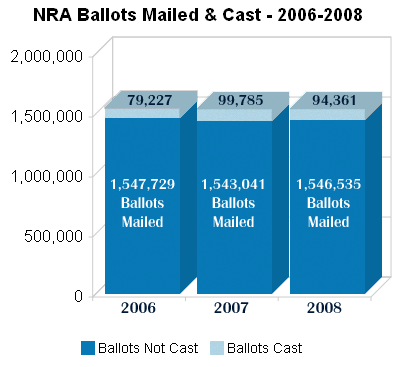
nravotescast06-08For a little bit of background on this data, the 2006-2007 sources are the annual meeting reports from the previous year that I managed to hold onto after recent NRA meetings.  The 2008 data was scribbled very quickly during the meeting in Louisville.
As you can see, during the last few years, voting member populations have remained quite stable.  Even though we know through anecdotal evidence that NRA membership was rising as the threat of a Democratic presidency rose, the number of voting members didn’t change substantially.  Based on this very limited data, we can reasonably assume that the biggest changes NRA sees in its membership are the folks who join for a year or two and then likely forget to renew or refuse to renew because their free hat didn’t arrive fast enough.  If you stay long enough to become a voting member, you’ll likely stay active for a long time.

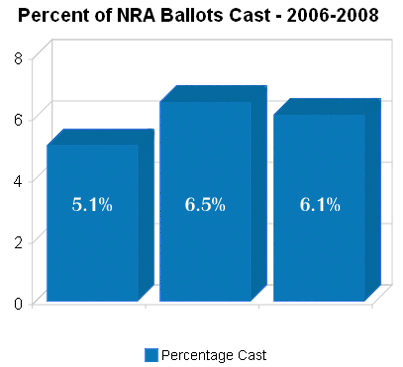
nrapercentvotescast06-08When working with such large numbers, it’s hard to see in the charts what the trends are  in terms of voting.  But by doing the math and plugging the percentage of ballots cast into a chart, we can get a better idea.  I have no idea if the overall percentage of voting members is really on the rise.  By only looking at three years of data, it’s impossible to see a trend.  In 2006, there were few “celebrity” candidates, which may have lead to a depressed turnout.  But, 2007’s biggest “celebrity” name was Ollie North, and 2008 was Tom Selleck.  I would expect that Tom Selleck would generally be able to inspire more folks to return their ballots than Ollie.

While we wait for Sebastian to finish up his Board Member interviews, tomorrow I’ll do a post on how many people screw up their ballots – and the many bizarre ways they find to get it so very wrong.

The Lion’s Den

Given the recent dominance of gun bloggers on the Examiner.com sites, it would probalby the last place I’d want to take an anti-gun stance.  Howard Nemerov gets to him first, it seems.  I would ask Mr. Mallowe to look at Pawlowski’s murder’s criminal record, and the various other high profile killers in Philadelphia which I’ve profiled, and seriously tell me the problem is with our gun laws.

Some Impressive Guns

Head over to The Firearm Blog for a few, first the Gardiner Gun in .45-7o government.  It’s a beautiful looking replica that Special Interest Arms has created (more pictures here).  Interestingly enough, hand cranked firearms are not considered machine guns under the National Firearms Act, and so are regulated just like any other long gun.  I’ve always wondered a few things about crank guns legally.  For one, if you were to attach a drill motor to the shaft, you’d be guilty of possessing an illegal machine gun.  So do you have a constructive possession problem owning a drill and a crank gun?  Also, if you look at the federal definitions of rifles and handguns, a mounted firearm is neither designed to be fired with a single hand, nor fired from the shoulder.  How is a crank gun not an AOW?

Second we have more two and four bore guns.  These guns are huge:

When it was nearly finished and needed to be sighted in I got the pleasure of helping do that job. The 4 bore exerts 255 PSI at 32 FPS of felt recoil(if I remember the number correctly), and I can tell you that at 6′ 5″ and 240 pounds and being very experienced with big bore guns, it was still more than enough to push be back a quick two step. And after 2 shots left me black and blue for about 5″ around my shoulder area(part of that was because the rifle was built for a smaller statured person so it really didn’t fit me). But the owner of the 4 bore shot it once and sent it back to Steve to sell.

I get sore shooting my Mosin-Nagant over 60 or so rounds.  I can’t imagine what it feels like to shoot a gun that bruises you on the first shot.

Poaching is Serious, But Not a Felony

There’s a proposal in Pennsylvania to make poaching a felony level offense under some circumstances.  I can’t agree with this:

House Bill 97, sponsored by House Game and Fisheries Committee chairman Edward Staback, proposes to do just that for a variety of wildlife violations. The 21-page bill would create felony-level offenses, with the possibility of imprisonment, for significant poaching activity. The bill, which was introduced and referred to the Game and Fisheries Committee on Jan. 28, has 23 co-sponsors, none of whom is a local elected official.

“This [bill] would elevate the punishment for those who willfully steal Pennsylvania’s wildlife resources to the same degree as any other major theft offenses,” said Carl Roe, Game Commission executive director. “Presently, such violations are classified as summary offenses, which are on par with a traffic ticket.”

The most it ought to be is a low misdemeanor.  One hangup the sponsor has is the fact that NRA would not back the bill with language in it to confiscate the firearms of poachers.  That has now been taken out.  I hope the NRA will not back this bill even without the language in it.  Anyone found guilty of felony poaching will have all their firearms confiscated for life, because they will become prohibited under federal law.

I don’t have a problem with certain, more serious poaching offenses being a low level misdemeanor, but not a felony.  Poaching is often something done by young people with poor judgement.  People shouldn’t have their lives ruined by it.