The Weekly Standard to the Bathyscaph WaPo

It’s got to be difficult getting the message down so far in the tank, but Mark Hemingway of the Weekly Standard is trying:

And the NRA bears responsibility here how? There is no concievable law enforcement scenario where putting 2,500 guns into the hands of criminals would be justifiable. Ever. The ATF should take it’s lumps, and anyone who suggests that gun rights advocates are to be blamed here should have their head examined.

I’m going to agree with Mr. Hemingway’s assertion that we ought to get to the bottom of this before drawing conclusions. To anyone who isn’t the Washington Post editorial board, that’s really the most sensible thing.

NSSF Responds to McCarthy

They set the record straight here. I’m surprised they didn’t say anything about living in gated communities. Given what a cottage industry most firearms manufacturing is, the accusation by Chicago’s top cop was risible. Hell, I’d be surprised if the Cerberus Capitol people, who own Remington, a large manufacturer, and many other smaller ones, are still living high on the hog given all the money they lost with Chrysler.

What Does it Take to Win an NRA Board Seat?

I’ve been told by successfully elected NRA board candidates that the data & explanations I provide about how NRA elections work and what it takes to win are actually pretty useful. So, if you’d like to see a change made to the NRA Board of Directors, here’s a peek at what it takes to help your preferred candidate win.

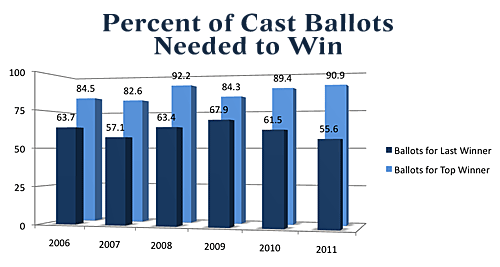
For those of you who are a little confused by my terminology, it is based on how directors are elected.  There are 25 seats up every year on the mailed ballot.  There are typically around 30 or so nominees, but only the top 25 of them will receive a seat on the board.  (There were 37 nominees this year, a higher number than usual.)  By “top winner,” I mean the person who earned the most votes.  By “last winner,” I mean the person who had the least number of votes, but still enough to win one of the 25 seats available.

This year, the top vote-getter was on 91% of the valid ballots.  Considering that exactly 3 years prior, the number was similarly high, it’s not hard to guess that this year’s top winner was once again Tom Selleck.  The final person to actually win a board seat was on almost 56% of the valid ballots. In raw numbers, that means that in order to serve on the board, candidates had to earn at least 53,029 votes this year. (This is actually the second lowest number of votes needed to win since I’ve been keeping track, typically the number is closer to 60,000 votes.)

The difference between the last winner and the “first loser” (for lack of a better term) was just 866 votes this year. Here are the candidates who did not win a seat and the number of votes between them and the next person in line.

“Losing” Candidates Vote Tally Difference from
Previous Candidate
Timothy W. Pawol 52,163 866
Harold W. Schroeder 51,566 597
David G. Coy 50,611 955
Carl B. Kovalchik 50,244 367
Steven C. Schreiner 49,952 292
James L. Wallace 45,157 4,795
Eddie Newman 45,154 3
Joel Friedman* 43,906 1,248
Dennis DeMille 37,970 5,936
Marion Townsend 36,744 1,226
Anthony J, Chimblo III 36,722 22

*Elected as 76th Director to serve a term of one year. The election process for this seat happens at Annual Meeting & is open to all NRA members.

You can see where encouraging any friends and family members who can vote to support your favorite candidates can easily pay off in boosting numbers. You don’t have to convince all 4 million members of NRA to support your guy or gal in order to make a difference in the election.

Probably Not Constitutional

Mayor Helen Thomas of Darby is a MAIG mayor, so we should not be surprised to find out she doesn’t have much respect for other civil liberties either. Apparently she’s imposing a state of emergency:

An 8 p.m. to 6 a.m. curfew is in effect for adults and juveniles for at least 10 days.

Anyone outside during that time can be stopped and questioned by police, though Police Chief Bob Smythe says they’re more concerned about groups loitering or causing trouble.

I’m somewhat familiar with Pennsylvania’s emergency powers statutes, and I do not believe that anyone in Pennsylvania has the authority to declare a state of emergency except the Governor. Even then, the statute does not give the Governor the power to suspend constitutional rights.

Thomas is also going to have difficulty with the Supreme Court case of Papachristou v. Jacksonville. It seems quite unlikely to me that a curfew imposed on adults, by a mayor likely acting outside of her legal powers, in response to ordinary crime, rather than riot or disaster, would pass constitutional muster.

Garry McCarthy is Slime, Just Like His Boss Rahm

By now we all know the story of Garry McCarthy, the Chicago Police Commissioner who recently went on an anti-gun tirade at Father “Snuffy” Pfleger‘s St. Sebastina Chucrh:

McCarthy has a history, and it’s not exactly good. Take this article from the New York Times which details a previous arrest, and his being disciplined by the NYPD:

Mr. McCarthy does not come without some baggage. Some critics have described his demeanor as occasionally gruff, and there has been much talk in New York about a confrontation last year in which he was arrested by two officers with the Palisades Interstate Police at a gas station on the parkway.

In March, a judge fined him and his wife $200 each for blocking traffic with his police-issued vehicle while they argued with the officers, who had issued a summons to their 18-year-old daughter, who was driving another car. At the hearing, the officers testified that Mr. McCarthy had been drinking and that he used profanities during the confrontation, which started after his daughter parked in a handicapped zone.

In an interview last night, Mr. McCarthy was unapologetic about the incident, saying he was simply protecting his daughter. “I will stake my career and reputation against any of the people involved in the incident,” he said.

In 1983, Mr. McCarthy was disciplined by the New York Police Department for an incident in the Bronx on St. Patrick’s Day, during which he was off duty and drinking when he and his brother, then a state trooper, were confronted by a group of men with a growling dog on a leash. During the dispute, Mr. McCarthy gestured to his gun, he told officials at the time. Mr. McCarthy acknowledged that his conduct was inappropriate, but that it was accepted practice at the time. “That was 23 years ago,” he said. “I think the more important thing is that crime in New York is down 40 percent since I became deputy commissioner.”

McCarthy was previous Police Commissioner for Newark, New Jersey, when the department was investigated by the feds for what the New York Times reports as “brutality, baseless searches, intimidation and false arrests.” Second City Cop reports that McCarthy and his brother were also allegedly shooting out streetlights and hurling racial slurs in the 46th precinct in New York City after they left a cop bar intoxicated. Here’s even more dirt on the guy.

This is someone we supposedly can trust with a gun, but the rest of us? Not to be trusted. This guy is a thug with a badge. I’d like to see those int he gun control movement try to justify this a**hole.

We Don’t Need Castle Doctrine or High Cap Magazines

The city politicians who believe this title need to explains the bands of feral teenagers wandering their city and beating people to the point of hospitalization. Given that we know the city will prosecute you for defending yourself against people intent on just giving you a thorough beating, it’s yet another reason not to go into the city.

According to the police report of the incident, Guendelsberger was “jumped” by 30 to 40 men who punched and kicked her numerous times. Police said they checked the area for surveillance but had no luck.

Shortly before Guendelsberger’s assault, police said, they responded to another assault, about five blocks away at Broad Street and Fairmount Avenue, of a 20-year-old man who said that he was attacked by a large group of men and women.

Police said that he was treated for a bruise and abrasion under his right eye.

Twitter users said that the mob ranged from 50 to 100 people and that participants not only assaulted people but also threw trash cans and lit fireworks.

I’ll be honest with you, it’s getting to the point I don’t know if you can carry enough gun in that city. The politicians who run the city should be ashamed. Green St. and Broad isn’t exactly the ghetto.

Fast and Furious All NRA’s Fault

That would appear to be the conclusion of the Washington Post.

Now, the very critics who have tied the bureau’s hands are expressing outrage over a novel, and we would agree questionable, ATF operation intended to curb gun smuggling into Mexico.

If they get any deeper in the tank for this Administration, they are going to need one of these. Their conclusions do not fit what’s come out so far in the hearings. We know, for instance, that ATF did not “lose track” of these weapons. They did not bother to track them at all.

NRA Election Participation

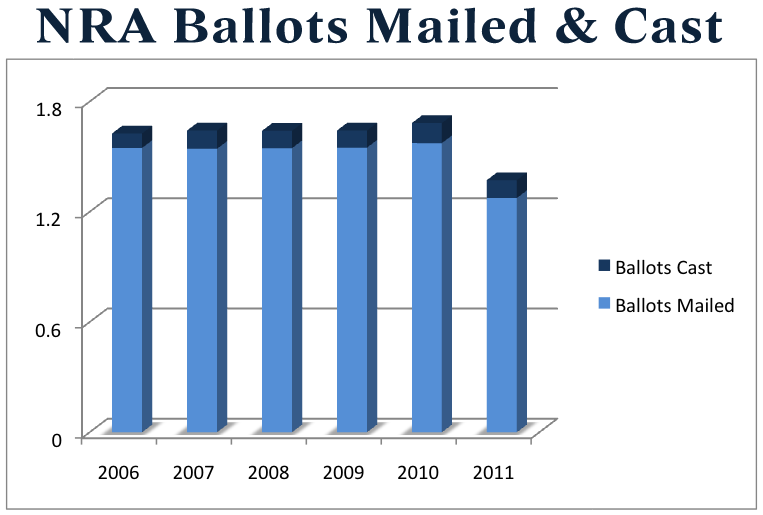
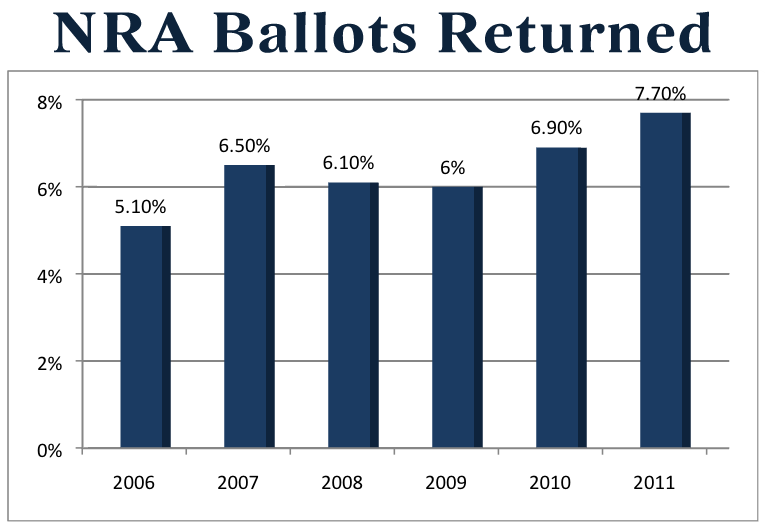
Ah, it’s time for the annual peek at how NRA members are participating in their elections. And this year, the data gets a little more interesting. But just a little. It’s still ridiculously easy for members to get their ballots in and actually influence elections. Let’s get on with the pretty charts.

The y-axis should say that the numbers are in the millions, but after battling with Excel and Google which have both altered their charts just enough to make it a pain in the neck, I figured you fine folks were smart enough to figure that out.

So, why were fewer ballots mailed out? Is NRA shedding massive numbers of life members or 5+ year members? While I don’t have direct access to data, I’m going to go ahead and rule that out. The fact that an even number of ballots went out indicates at least the beginnings of a membership list cleaning operation – putting real effort into finding out who is alive, who moved, etc. Every organization has to do it periodically, and timing to when you have to mail out ballots makes the most sense. One of NRA’s biggest expenses is mailing out the magazines to nearly 4 million members, it gets more expensive when you add stuff to it like the ballots.

I make my assumption with some evidence to back it up. The number of ballots that came back was actually the third highest since I started keeping records, and the number of invalid ballots (those with mistakes) is on par with previous years as well. Those numbers did not see a proportional drop.

Because of the drop in number of mailed ballots, the participation rate went up. Since it’s unlikely the dead people were voting, this makes sense. This isn’t Chicago, after all.

When I emphasize that it’s, in theory, ridiculously easy to influence the election, it’s totally based on the fact that so few eligible members actually vote. If the majority of Snowflakes in Hell readers are voting-eligible members of NRA and every one voted, they alone could throw the participation rate up to 10% based on this year’s numbers. In that spirit, if you do receive an NRA ballot and choose not to vote, I’d be curious as to why you don’t vote in the association election.

The Problem of Drug Discovery

Well, this is my last week of employment, and while I am no longer actually working, I’m still having a hard time not thinking about work. It is very difficult to accept that the idea I signed up with at the very beginning ten years ago may be dying. Despite the dissolution of my current employer, a few of us true believers stood a good chance of saving the idea by forming a new entity, with a leaner and more focused organizational structure. This was possible since we had people who seemed willing to give us money. Unfortunately, the party with the most money is probably walking away, which if it does not spell the end, will definitely make putting something together take longer than most of our wallets can tolerate. We are not giving up, but we do need a paycheck.

One of the great difficulties in biotech is that everything is expensive, and you basically can’t operate in this business without venture capitalists, or without cozying up to a company in the Big Pharma club. That’s difficult for a discovery based company. Venture Capitalists are hesitant to invest in companies that are discovery stage, and Big Pharma is reluctant to pay large sums of money for pre-clinical compounds, unless they are hot and difficult targets they themselves have not been able to make any headway on, and even then you’re talking a million or so up-front, typically, with most of the money coming down the road with milestones and royalties.

We figured to run a program to the point where we can partner it it would cost about a million and a half dollars. It might end up being cheaper, but that depends on a lot. A sum such as that is beyond what you can easily finance with angel money, unless you can find an angel, or several angels, with really really deep pockets. Most individuals don’t have that kind of money to drop on a gamble. And because the drug business is a gamble, you will probably need several shots on goal before you’re going to hear the ca-ching of being a winner. Really, you probably want to have enough to do 3 to 4 programs. That means tapping VCs.

Typically how this would work is you develop a compound to a certain stage in the drug life-cycle, then partner it. Obviously, the farther you take it yourself, the more it’s worth when you partner it. It’s feasible for a well financed biotech to take compounds into Phase-II clinical trials. Phase-III is typically the most expensive, since you’re blowing you trials out to large numbers of patients. But going into the clinic is very expensive. Even going into animals like rats isn’t cheap. So the question is where the sweet spot is, where you can make back your cost, have enough to fund another program, but not dump so much money going into the clinic that you assume a large amount of risk yourself. Many biotechs have taken single products into the clinic, had them fall out, and then closed their doors. But taking risk in this business pays, so there’s a balance.

The biggest problem in seeking Big Pharma partners is that the business is so turbulent right now, it’s difficult to work out deals. We had more than several cases of partners either pulling out of deals, or canceling projects in place because of internal politics in the partner, or because management at a higher level in the Big Pharma partner decided to can the work on the project. Internally to Big Pharma, that happens all the time, but if you only have a few partners, and one walks away, it can be devastating to a biotech.

The Venture Capital landscape isn’t much better. VCs seem to prefer investments in companies that have compounds in the clinic. There is money out there for discovery stage compounds, but the bar is set very high for those companies. You won’t raise any money talking about how wonderful your idea is, or how great your people are. They probably won’t understand your idea, and if you don’t have the pedigree to back up how great you are, and by pedigree I mean either you’ve won the nobel prize, have already made million in biotech, or are known in the industry for having produced a blockbuster drug, they basically don’t want to talk to you.

I’ve spent the vast majority of my career in this business, and I’ve been questioning it. The fundamental problem with biotech and pharma is that the barriers to entry are so damned high. Even if you decide to depend on a Big Pharma partner for the most expensive part — clinical trials — experimental science is still awfully expensive. In other technological fields, like software and computers, the barriers are so low it’s not all that out of the question that if you grow lethargic, arrogant, and wasteful, some punk-ass kid right out of college is going to come along an own you. I like that kind of competitive environment, because in businesses like that, people tend to stay sharp, focused, open to new ideas, and open to change. That is not the drug business.

The good reason to stay in pharma/biotech is that if you do it right, there are fortunes to be made. If you produced a drug that people will take every day for the rest of their lives, in areas like cholesterol, blood pressure, or inflammation, you basically have a license to print cash by boxcar load for as long as the patent lasts. Typically in biotech, there’s a provision for a royalty to be paid if the compound is approved by the FDA and makes it to market. This is typically a few percent. But think about this: Lipitor did close to 13 billion dollars in global sales last year. Even one percent of that is nothing to laugh at. But even though the sums of money are huge, you’re going to end up sharing more of it with VCs than you would in many other industries, because of the costs involved.