
Thirdpower reports that it looks like he’s stopped blogging, presumably because the money has dried up. That’s the problem with astroturfing campaigns — it takes money to keep them going.
Category: Guns
Pro-Gun Op-Ed In New Jersey Media
An attorney that works with ANJRPC currently has an Op-Ed in North Jersey media market that suggests why the Garden State’s gun laws are unconstitutional:
As it turns out, New Jersey gun law offers fertile ground for challenge, not merely because the state has such strict laws but because New Jersey law is exceedingly aggressive toward the law-abiding gun owner.
New Jersey’s regulatory scheme is highly unusual in that it approaches gun control by categorically banning guns and then carving out extremely limited exceptions to the prohibitions.
Read the whole thing. New Jersey’s gun laws are designed to frustrate the exercise of the right by making it exceedingly legally hazardous to own and transport firearms. Despite anti-gunners claims to the contrary, it’s hard to see how it’s constitutional to start out with the default assumption that all guns are banned.
UPDATE: More here.
It Must Have Been Painful to Write
I’m guessing typing every word was pure agony, but over on the Brady Facebook, it seems they had to do a bit of “Let’s stay focused” on some of their Facebook Fans:
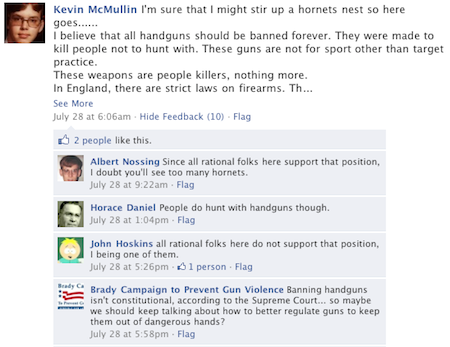
Every rational person supports that position, except, apparently for the Brady Campaign. What if their core supporters don’t want to “better regulate guns to keep them out of dangerous hands?” Will they keep donating if the best they can hope for is to make all sales go through an FFL?
In other news, it looks like pro-2A voices can get through the “Reasoned Discorse” filter on the weekends when they probably aren’t paying attention.
“Shoot Me First” Vest for iPad
Who knows, maybe the device could stop a bullet. But hey, if Steven Jobs makes concealed carry wear fashionable because people need a way to carry around iPad’s, that’s fine by me.
Thirdpower on Appleseed
Thirdpower gives an account of his recent Appleseed experience. The program he described sounds unequivocally positive. I suspect there is a good deal of variation in the program, depending in who’s running it, but if Thirdpower’s program is more the rule than the exception, there’s not much wrong with it.
Good to see those new Irish gun control laws …
… working so well. See also here.
Pro-Gun Article in Honolulu Media
As the “bad” states go, Hawaii probably has more in common with Maryland than with California, but it’s not exactly a pro-gun media market. It’s interesting that the Honolulu Star-Advertiser is willing to run a positive puff piece on shooting, and even offering links to help get started in the sport. Wow.
AR-15 .22LR Conversions
Chance Ballew, who wields a mean pink rifle, takes a look at how you can save money on shooting with a 200 dollar kit that will pay for itself in the first brick of ammo.
Serial Numbers Upheld by 3rd Circuit
This ruling strikes me as largely correct:
Scirica, who was joined by 3rd Circuit Judge Michael A. Chagares and visiting U.S. District Judge Joseph H. Rodriguez of the District of New Jersey, looked to First Amendment law in deciding that the federal ban on guns with obliterated serial numbers should be subjected to “intermediate scrutiny.”
But even if the law were held to strict scrutiny, Scirica said, it would still pass constitutional muster.
“Serial number tracing serves a governmental interest in enabling law enforcement to gather vital information from recovered firearms,” Scirica wrote, “Because it assists law enforcement in this manner, we find its preservation is not only a substantial but a compelling interest.”
Overall I think this is a reasonable ruling, and shows the courts are willing to take the Second Amendment as seriously as other constitutional rights. The fortunate thing here is that Judge Scirica rejected a rational basis test, which was asked for by the US Attorney, and made the comparison directly to the First Amendment. Orin Kerr has more here, including a link to the opinion itself. Eugene Volokh is cited.
So it would seem at least that three judges of the Third Circuit are willing to treat the Second Amendment fairly. This is encouraging.
New York Times Article on Appleseed
By New York Times standards, this is remarkably balanced, which is to say the reporter went around to Appleseed events and reported on people he thought were whack jobs. I’ve had my issues with Appleseed, as I posted a few years ago here, here, and here, but mostly centered on the question of whether it was meant to bring people into shooting, was something for casual shooters to get them more serious, or was something to get people thinking about revolution. It never seemed to me that it’s a good program for the first and last, but could be for the middle purpose.
But after talking to a lot more people who have shot Appleseeds since then, I’ve become less concerned and more ambivalent about it. People seem to get out of it what they expect to get out of it, and you can’t really argue with that. But I actually think someone the reporter interviewed hit on the essence of what drives Appleseed:
But the sociologist James William Gibson, whose book “Warrior Dreams†analyzed civilian paramilitary culture since the mid-’70s, says Appleseed and the broader movement around it are unlikely to pose a danger to civil society. “When a culture is in crisis, the first response is often to go back to the creation myth and start over again,†he told me. “The narrative is ‘we’re going to redo the narrative of the United States by returning to origins, to marksmanship.’ People are focusing on the idea that America’s problems can be resolved into something that can be shot. It doesn’t exactly encourage systematic reflection, but it’s a long ways from a civil war.â€
I’ve neve been one for myths, and although I very strongly believe in an armed populace as a deterrence against governmental malfeasance, I think we too often make the mistake of assuming that’s going to take a similar form to 1776 — that a nation or riflemen will triumph over a much more powerful conventional military mostly with small arms and light artillery. If our government were taken over by people with less than Republican virtue, I have a tough time believing resistance would take that form. I’m struck by this passage:
When American men talk like this, they are usually giving voice to fantasy. Only in fantasy, after all, are governments overthrown by men trained to do nothing more than shoot long-distance targets in a controlled environment. Some of these men seek out unlikely battlefields, where they can be warriors of the future, warriors of the imagination or reluctant warriors in waiting who are passing their time on the Internet. The power of a gun to take a life is not so much a threat as a talisman connecting these fantasies to the real world.
This probably hits at the heart of the real problem I have with Appleseed, but not for the same reasons as the New York Times reporter, who seems to hint that the notion of an organic Revolution is quaint and silly, rather than that Appleseed is only focusing on a small part of the picture.
I would argue the man or woman who thinks about how to build UAVs, or knows something about robotics, chemistry, or engineering, has as much of or more of a contribution to make towards an organic militia of the people than someone who can hit a man sized target at 500 yards. That’s not what we want to hear because it’s not the founding narrative of America, but that’s the reality of modern asymmetric warfare. It’s not that small arms would have no role to play in such a doomsday scenario, they certainly would, but they would only be one part of a much larger picture, and the kinds of rifle shooting taught by Appleseeds would be an even smaller part of that. That’s kind of why I question what Appleseed is really trying to accomplish, not because I think it’s necessarily bad, but because it doesn’t seem to fit into a category outside of just teaching people how to be a better high-power shooter. That’s certainly a laudable goal, but what’s the goal in bringing in the rest of the ideas?
When it comes to preparing for the worst, there’s no need to make plain about what you’re doing. Shooting is a lot of fun, and you can teach it to people that way. Robotics is also a fun hobby. Model airplanes anyone? Look how much fun Joe’s Boomershoot is. Piloting UAVs? Plenty of flight simulators out there. Let’s also not overlook the value of computer hacking.
My purpose isn’t to disparage small arms, because they have a role, but to make people think about the problem. This isn’t the weapon, just a tool. This is the real weapon. Despite various assertions that your average American is a sheep, I have a pretty strong faith that if things got bad enough, that if, as one of my favorite federal judges said, “where the government refuses to stand for reelection and silences those who protest; where courts have lost the courage to oppose, or can find no one to enforce their decrees,” that Americans will rise to the occasion. If that does come to pass, we’re going to need a much wider variety of skills than we did in 1776. This wouldn’t be a rifleman’s war. Learning how to shoot targets out to 500 feet is certainly fine, but it’s only a small part of the overall picture. That is, if you’re about more than just teaching people how to be better shooters.