
Bradys: Trying to be Relevant

The Brady folks must be pretty desperate to try to remain relevant when the DNC has largely been focused on just about every other lefty issue that isn’t theirs, and they are begging the DNC to say something nice about their cause, and reminicing about the Clinton years when they could sit at the cool kids’ table.

Of course, the lack of attention to the gun issue plays both ways. For instance, I’m covering the conventions because there just isn’t any relevant gun news out there. All that’s coming across my Google Alerts and other sources are the dozen or so armed citizen stories I see per week. You know, the ones the Brady folks claim never happen*. I’ve made an editorial decision not to cover armed citizen stories unless there’s some unusual angle that makes for an interesting post. But I will say, I’d prefer to be on this side of things than theirs, where armed citizen stories are too banal to blog about, rather than begging to be relevant because my issue is as dead as Carrie Nation.

* Just in case the Brady supporters want to say I’m exaggerating about what I pass up. See here, here, here, here, and here. That’s just a few days worth. These gets picked up by local news outlets. You never see it picked up in national news. Doesn’t fit the narrative.
Trying to Undo Campus Carry in Colorado

Looks like the anti-gun folks in Colorado are busy seeking allies in the fight, but it looks like the Boulder City Council is hesitant to get involved. Our experience here in Pennsylvania has taught us that local political bodies are a poor ally in a statewide legislative fight. It hasn’t really helped the anti-gun folks here with their agenda very much. If the anti-gun groups in Colorado are looking to city councils for allies, they are probably having a hard time finding allies to get behind them in this fight. That’s good news for us.

The Gun Room in City Hall

A look, by a reporter who feels the need to explain his qualifications:

I am not exactly a gun virgin – I have been to a shooting range, and I have a brother who hunts. I’ve never gone hunting with him, though I’ve politely inspected his three guns and his crossbow. That’s about it for my exposure to actual guns. I am well-versed, however, in the concept of guns. I’ve written for years about the corrosive, violent gun crime that plagues the city.

The concept of guns – the arguments, the fretting, the hand-wringing over the havoc they cause, the arguments over the Second Amendment – has nothing to do with confronting real guns, especially in the Gun Room.

You’ve been to a shooting range once? This my friend, means you have no business or knowledge to be opining on this topic, and should stop right here, any more than I have knowledge to have an informed opinion on proper veterinary care because I once dissected a frog in biology class in high school. The author goes on to call us uncaring liars, who don’t give a damn about gun violence. If you have a subscription to the Daily News, cancel is now. Starve the beast!

Schumer Thinks Bloomberg was Unfair to Obama on Guns

Schumer has been an anti-gun leader in the Senate for years, and he’s obviously playing the long game on guns, defending Obama against attacks on his gun record from Bloomberg,. The best chance the other side has of erasing the Second Amendment from the Constitution is to give Barack Obama a second term. I’m really surprised more of them aren’t seeing that.

Another Case of Brady Deceit

The Brady folks often can’t talk about this issue without spinning a tale. I think what often surprises me is that sometimes the data can make a case for them, even without the tale. It’s like they are so strongly committed to the deception, that they can’t break their mental mindset. Such is the case with this latest article, guest written by Griffin Dix, Ph.D, talking about how wonderful California’s gun laws are. A model for the nation:

Before 1997 California’s firearm mortality rate was consistently higher than that of the rest of the nation. But as California’s gun laws took effect the state’s gun death rate dropped lower. Of course many factors besides gun laws affect firearm mortality rates.

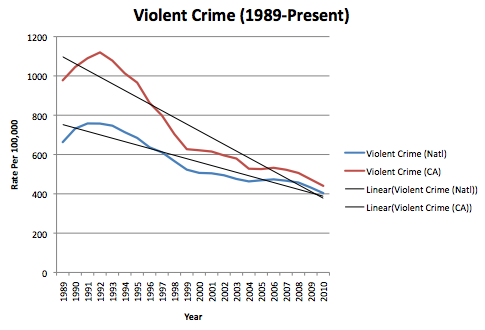
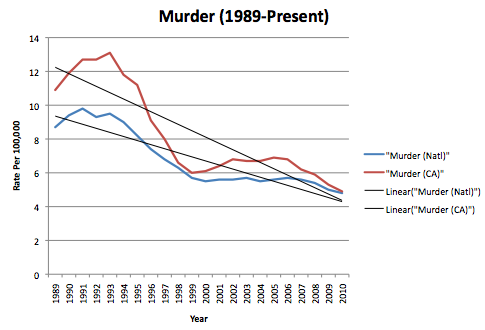
There’s that sleight of hand again, discussing firearms mortality rates, of which the vast majority of which will be suicides. But if you look at overall violent crime and murder, from the data appearing at this source here, and here, you can see that California still has a violent crime rate significantly higher than the nation as a whole, despite the fact that the vast majority of the rest of the population lives under what Brady would classify as unacceptably weak gun laws.

Violent Crime in California v. US

Murder in California vs. US

Perhaps it is a desire on the part of the Bradys to make gun control look more miraculous. Maybe they feel it doesn’t make for so compelling a case to suggest that California’s murder and violent crime rates are indeed dropping faster than the rest of the nation, without controlling for other factors. Or perhaps they recognize the number of potential donors impacted by suicides is larger, and wish to cultivate that potential donor pool more than victims of criminal activity?

UPDATE: I used a stacked graph by mistake, so the numbers were shifted. It is corrected now.

Taking it on the Chin

I’ve shot an AR-15 pistol with a cheek weld on the buffer tube, and I didn’t find it recoiled that heavily, so I don’t think this would be as uncomfortable as it looks.  As to whether it can get around the NFA requirement, as Uncle discusses, I wouldn’t care to wager. ATF has ruled that anything that makes it “designed” to be shot by two hands is an “Any Other Weapon” (AOW), not a pistol, so foregrips on pistols make it a Title II firearm, but hand guards are fine. The risk here, as I see it, is that it would be easy for ATF to suggest that the chin stock makes the firearm such that it’s no longer “designed to be held and fired by the use of a single hand.,” which is the legal definition of a pistol. If something isn’t a rifle, shotgun, pistol, revolver, or a machine gun, it’s an AOW. It could go either way, in regards to whether it’s an AOW. The issue is “designed.” You can cheek weld a buffer tube, because the buffer tube isn’t “designed” into the gun for that purpose. But ATF also allows handguards over the barrel of a pistol, such as this. So who knows? And let’s not even get into how a pistol grip shotgun is neither a pistol, nor a shotgun, under federal law, but also can’t be an AOW.

Once you realize how much ambiguity there is in the federal statutes regulating firearms, the idea of a hostile administration who is hell bent to screw us, because, you know, he doesn’t ever have to face voters again, should scare the hell out of you.

Comparing Platforms

Jacob compares the Democratic platform to the Republican platform, when it comes to guns. I pretty much agree with Jacob when it comes to the meaning of party platforms, but it’s interesting that the Democrats felt the need to blow some sunshine up the posteriors of our opponents. As SayUncle notes, to their request for an open an honest discussion about firearms, “ We had that already and the gun control side lost.”

The Gun Went off “Accidentally”

This is apparently what people in the UK are saying when they find themselves having to shoot home invaders. An admission, apparently, that the shot was deliberate, would be an immediate invitation to be charged with murder. But apparently that doesn’t necessarily apply if you’re a copper.

Revisiting the Treaty Power?

Ilya Somin notes that Bond v. United States could possibly be going back to the Supreme Court, with a question that raises the Treaty Power of the United States. The treaty power is currently interpreted by the Courts to be an independent power that can be separately exercised from Congresses other enumerated powers, so the normal federalism limits don’t apply when it comes to a treaty. No treaty can stomp on the Bill of Rights, but beyond that the treaty power is fairly unlimited. I agree with Prof. Somin that this presents a problem:

I think the power to make treaties is best understood as a power allowing the federal government to make commitments regarding the use of its other enumerated powers, not a power that allows the federal government to legislate on whatever subjects it wants, so long as the issue is covered by a treaty. Among other things, the latter would enable the federal government to circumvent limits on the scope of its power by paying off a foreign power (e.g. – a weak client state dependent on US aid) to sign a treaty covering the subject.

I’d love to see the Supreme Court revisit this topic, and hold the treaty power can only be exercised within the scope of Congress’ other enumerated powers, but this would call a number of treaties into question, including those that affect hunting. I tend to think the Court will be cautious about a ruling that would affect current treaties.

The landmark ruling that lead to Congress’ treaty power being interpreted this way was Missouri v. Holland, which upheld the Migratory Bird Treaty Act of 1918. Since then the Courts have tended to limit this power. Of course, Missouri v. Holland was decided in 1920, when the scope of the federal governments enumerated powers were considerably more constricted, so today it would probably be possible to argue that the 1918 treaty is a legitimate exercise of Congress’ enumerated powers, and is therefore still constitutional, even if the Court decides to further limit the treaty power.