
New Language

I can indeed find some new language in this year’s castle doctrine, as opposed to last year, but so far I don’t see anything that should give us cause to withdraw support for the bill or seriously worry ourselves:

(2.3)  An actor who is not engaged in a criminal activity, WHO IS NOT IN ILLEGAL POSSESSION OF A FIREARM and who is attacked in any place where the actor would have a duty to retreat under paragraph (2)(ii), has no duty to retreat and has the right to stand his ground and use force, including deadly force, if:

The section in all caps is new. For most of us who are carrying firearms legally, this isn’t an issue.

(2.4)  THE EXCEPTION TO THE DUTY TO RETREAT SET FORTH UNDER PARAGRAPH (2.3) DOES NOT APPLY IF THE PERSON AGAINST WHOM THE FORCE IS USED IS A PEACE OFFICER ACTING IN THE PERFORMANCE OF HIS OFFICIAL DUTIES AND THE ACTOR USING FORCE KNEW OR REASONABLY SHOULD HAVE KNOWN THAT THE PERSON WAS A PEACE OFFICER.

This is new in this section. Without context it’s hard to explain, but I will try. In last year’s bill, you could not use the presumption set fourth that deadly force is justified against someone unlawfully and forcefully entering your home if that person was a peace officer performing his official duties. In a way it’s kind of redundant, because presumably a peace officer is lawfully entering a home, and if a peace officer were unlawfully entering a home, then that wouldn’t be part of his official duties, would it? This years bill adds that same provision to anywhere you have a legal right to be. My opinion is this is a feel good provision. Obviously a peace officer who’s in the process of, say, unlawfully raping a woman, isn’t “acting in the performance of his official duties.”

(d)  Definition.–As used in this section, the term “criminal activity” means conduct which is a misdemeanor or felony, is not justifiable under this chapter and is the proximate cause of RELATED TO the confrontation between an actor and the person against whom force is used.

You can see where last year’s language was struck and replaced with the language in caps. This is probably the language being talked about by the DA’s association. My guess is they were concerned about the burden of proving proximate cause, rather than just having to prove a relationship between the crime and the need to use deadly force, which is a clearer standard. I don’t seriously object to this change.

The rest of the bill is identical to last years, including the civil immunity provisions. My feeling is the changes promoted by the DA’s association are relatively minor and are a reasonable concession if in return they drop their opposition to the bill. The DA’s association no doubt came to the table because they realized something was likely going to pass this session, and decided it was better to get some minor concessions than continuing to tilt at windmills.

That has probably been why this bill has moved so quickly and been voted on so overwhelmingly. Without the DA association’s objections to ride on, opponents of Castle Doctrine don’t have much political cover for their opposition, so they caved. I think the changes outlined were small concessions to make in order to get this bill to move quickly and get cleanly through the legislature.

DA’s Association on Castle Doctrine

Looks like the DA’s association has softened their opposition, but the reason is worrisome:

Now, Marsico says the DA’s Association is working with, and not against, Republican lawmakers, in an effort to change the bill’s language. New language the group helped craft would only eliminate the duty to retreat before firing if the other person is armed. “It also provides that the individual who wants to avail themselves of the expanded doctrine cannot be engaged in any criminal activity,” he said. “And prior versions of the legislation put the onus on the prosecution to prove there was no criminal activity. We’ve removed that with the current amendment.”  He outlined one more change: “The other thing in the current amendment does is that it provides that if someone’s going to claim the expanded stand your ground doctrine, and they use a firearm in defending themselves, then they have to be legally in possession of that firearm. So we’ve tightened the law a lot.”

I will do my best to look into this, but this could be cause for concern. I need to look at this year’s and last year’s bills side by side, but I’m pretty sure most of what they are speaking of here is already a feature of last year’s bill, IIRC.

Mega Earthquake

Hits Japan. This hits close to me because our major partner, that we’ve worked with now for a number of years, is a Japanese company, fortunately located farther away from the earthquake epicenter than most other Japanese cities, and well out of the range of tsunamis. We’re trying to get in contact to make sure everyone over there is OK. Also of concern is Bitter’s grandmother in Honolulu, though the Pacific Tsunami Warning Center isn’t expecting anything major.

They Have Some Nerve

Via Clayton Cramer, the Las Vegas Sun has some latest news from the Righthaven nonsense:

“Defendants have elected to needlessly increase the burden on this court and its staff and to increase the litigation costs incurred by the parties by escalating the litigiousness of the action. Righthaven contends that this is precisely defendants’ desired effect in this case — to drive up their attorneys’ fees and costs in an attempt to burden Righthaven with an astronomical fee award,” Righthaven said in a filing.

I have the world’s smallest violin here playing for these guys. It’s so small I don’t think Jason’s 3D printer could print it. Sucks when the table is turned, doesn’t it, Mr. Steven Gibson? I hope the Democratic Underground and the Electronic Frontier Foundation make Righthaven their bitch. This shakedown racket Righthaven has going should not be a viable business model.

Taking Some Time Off from Work

I have some carryover vacation from last year, five days to be exact, that I have to burn up before the end of March or lose it. For the next two weeks I’ll be taking Fridays and Mondays off, then for the last full week in March, a Friday off. I will try my best to not let this interrupt the normal blogging schedule, but needless to say I’m going to spend this time doing my best to reject my normal sleep/wake schedule by sleeping as much as possible.

I’m also not going to reject, outright, the notion of drinking during daylight hours during the periods when I have time off. This will either make blogging more interesting, or more hazardous. I will leave it to the reader to decide. But time not spent thinking about work is welcome, especially given the current circumstance of my work life being on the precipice of running out of cash to keep operating, which, sadly, includes running out of cash to continue paying my salary. Considering my strict “no pay, no work” policy, this is a disturbing possibility that could possibly be in my near future.

Grassley on Cam and Company

Cam Edwards interviews Senator Grassley (R-IA), who’s been spearheading the Project Gunrunner scandal investigation. Grassley is the Ranking Member of the Judiciary Committee, which is the highest minority party position. The Committee is chaired by Democrat Patrick Leahy of Vermont.

It Starts With a Design

The first step in figuring out how to print a magazine on a 3D printer is deciding which magazine to make. Those of you who know the gun can probably identify the magazine showing here as being to an M11 submachine gun. We selected this magazine for a few reasons.
One, there’s a factory design that’s made from all plastic, which gives us a starting point. Two, Jason has a legally owned M11 submachine gun.Three, it would be really cool to make a magazine that can keep up with a full auto cyclic rate. Since we’re still prototyping, and have not moved into testing, this might prove yet to be rather cocky. In truth I’d be happy to have one that keeps up on semi-auto.

But there are some difficulties here. The plastic M11 magazine is made from a molded thermoset polymer. These types of polymers form rigid cross-linked polymer chains during the curing process that while less flexible and more brittle, also tend to be fairly strong. MakerBot’s Thing-o-Matic extrudes ABS, which is a thermoplastic. Thermoplastics are less brittle, but also not as strong, and certainly more prone to flex.  On top of that, there are issues with the extruded printing technique. All of these mean it’s probably going to be impossible for our printed magazine to have a capacity that’s identical to the factory magazine because of the need to have thicker walls due to the limitations of our material and printer.

To the left you can see a CAD drawing of our current prototype. Due to the size limitations on the printer’s build area, it requires the magazine to be broken down into three different sections to be printed, and then glued together at the end. In the drawing you’ll notice there are round disks over or under some of the parts. This indicates the parts in question are to be printed standing up, and the disks are intended to stabilize the part during the printing process. After the print run is finished, the disks can be cut away with an X-ACTO knife.

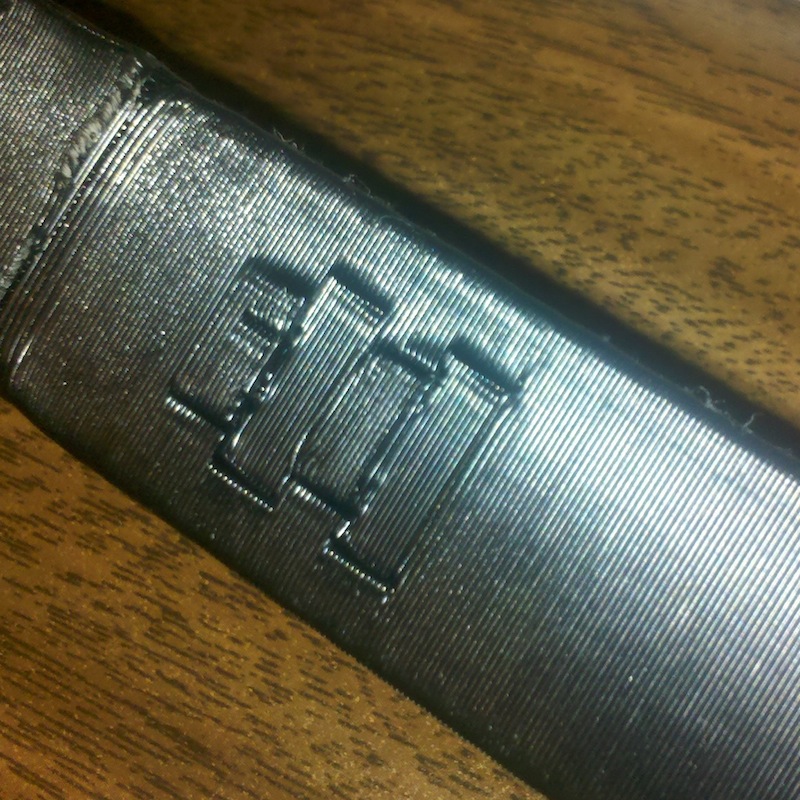
Showing above on the right (click to embiggen) a printout of an early prototype magazine. You will notice, if you look carefully, exactly how the printer extrudes. It builds layer on top of layer of strands of melted ABS that are fractions of a millimeter thick, resulting in the texture you see in the photograph. Unfortunately, these ridges provide a rough enough surface to encourage the magazine to hang up and jam. They can, however, be sanded out, but that’s painstaking work.

In further posts I will be talking about my follower design, and maybe I’ll see if Jason wants to come on and speak of some of the difficulties with doing the magazine body, and some of the steps that had to be taken to make it all work.