Righthaven’s Newest Target

In a somewhat ironic turn of events, Sharron Angle, Republican nominee for the U.S. Senate from Nevada, has become the latest Righthaven LLC target. I say ironic because Sherm Frederick, publisher of the Las Vegas Review-Journal, is reputed to be one of her biggest backers.

There is speculation that posts by liberal blogger and Reid supporter Steve Friess goaded Righthaven into filing the suit. Friess, who works for a sister publication of the rival Las Vegas Sun, had published instances of Angle’s campaign posting full articles from the LVRJ on her website.

Friends or enemies, rich or poor, Democrats or Republicans, they are all targets for “copyright-magnate” Steve Gibson.

The Project Runway judges need some history lessons

Watching Project Runway on the DVR and one of the challenges ended up with a collection designed with a theme of “Military and Lace”. Michael Kors made an offhand comment about the combination being an unusual combination. I think he should check out some historical uniforms…

(An amusing side note; I wrote up this post on my TX2 laptop, a predecessor of the one being pimped on the show.)

Rain Forests: The Hippies Can Keep Them

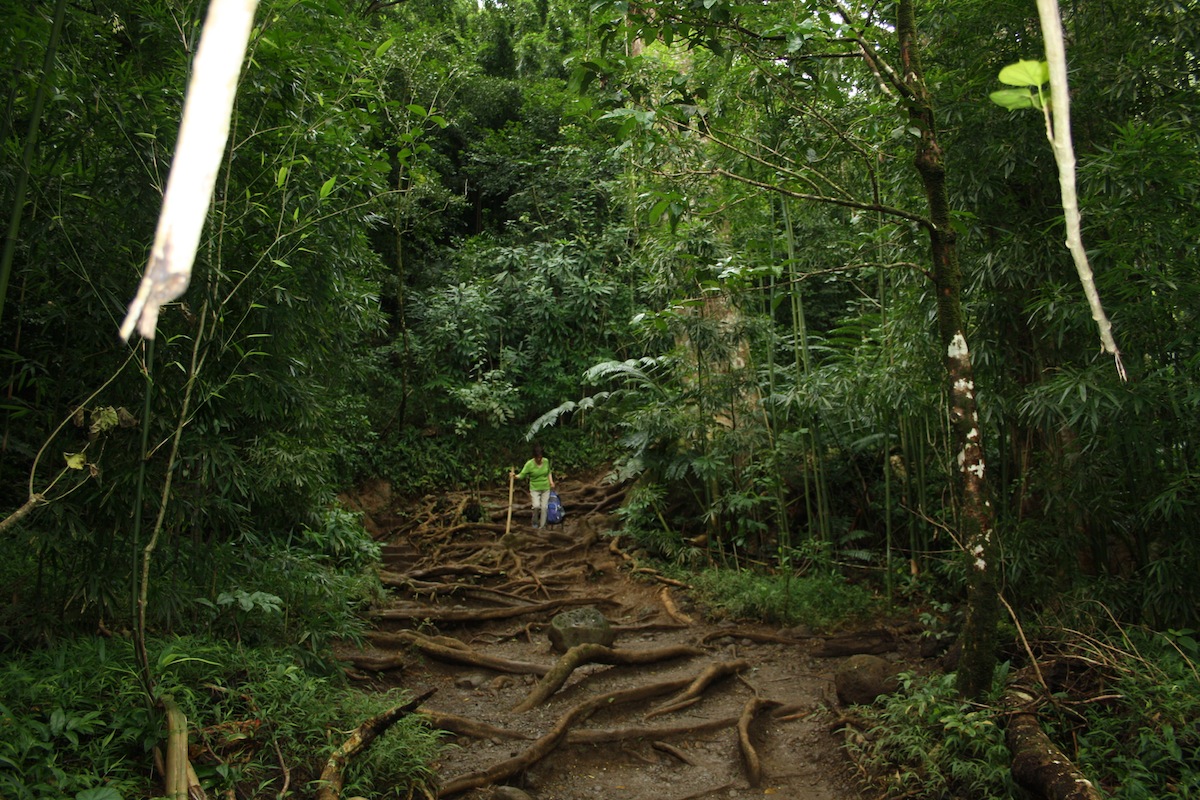
All we need are some monkeysWe’ve been following a guide book to Oahu for a lot of our trip. While it has certainly been useful, I’ve found following around filming locations from ABC’s Lost has actually been the better way to get to know the island. Today we did a hike from the guide book. The book describes it as a mild two mile hike (one mile in, one mile out). They describe it as a hike anyone can do. I suppose this is literally true, if you don’t mind a gentle romp through a fragile, naturally pure and beautiful rain forest, don’t mind getting covered in mud, eaten alive by mosquitos, climbing slippery boulders where a slip could mean a plunge to your doom. Mud and RootsThe only thing missing from this picture were screaming monkeys, which I’m happy about, given that monkeys are evil, and are best dealt with through use of instruments that the State of Hawaii has deemed me too irresponsible to carry.
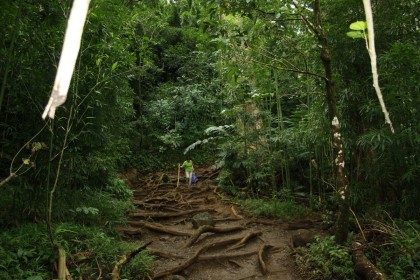
I’ve hiked enough to know how to deal with muddy, wet conditions, if I’m warned beforehand. But reading it was an improved trail, and we’re in the dry(er) season, I figured my kakis and an Aloha shirt would be fine. Oops. About one third of the way in, I suddenly realize I’m woefully overdressed for the occasion. But not wanting to give up, I trudge on, through the archways made through Banyan tress, slowly becoming more and more soaked with sweat Banyan Tunnelas the air, which is unable to accept any more moisture, fails my cooling system, which is adapted for the dry, african savanna, and not rain forests in Hawaii.

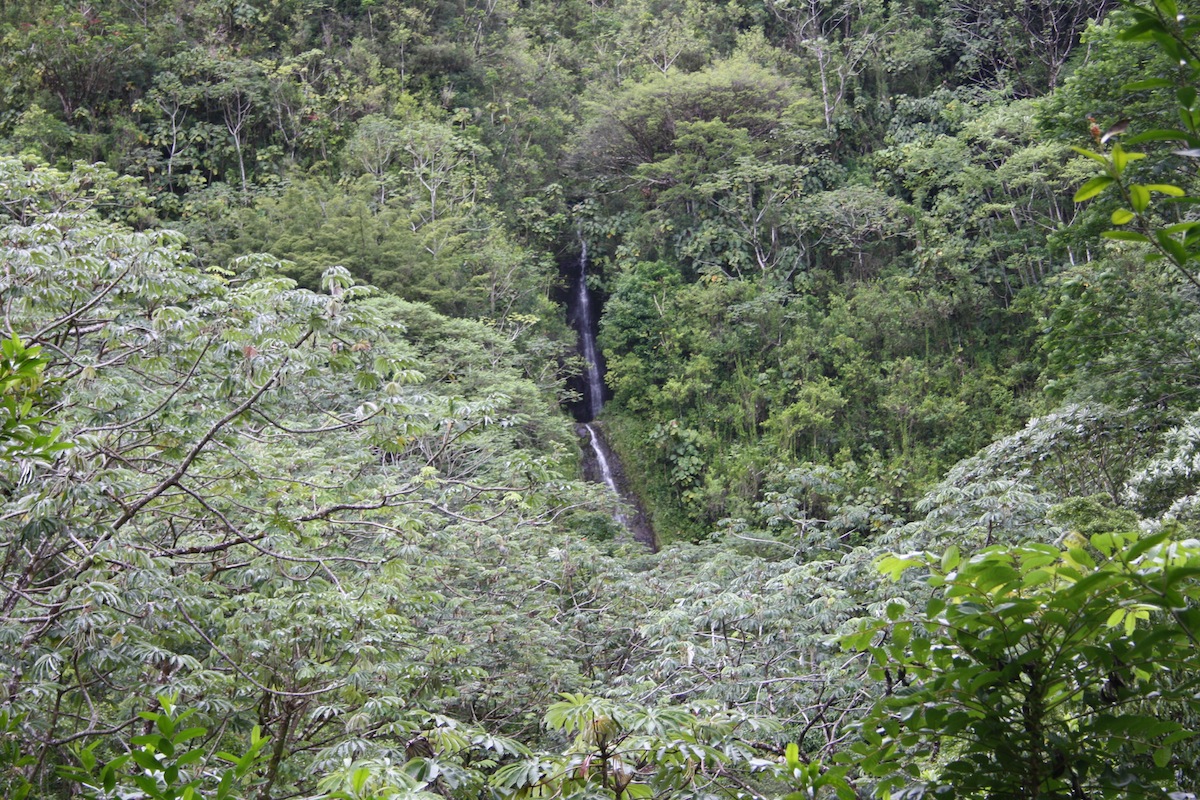
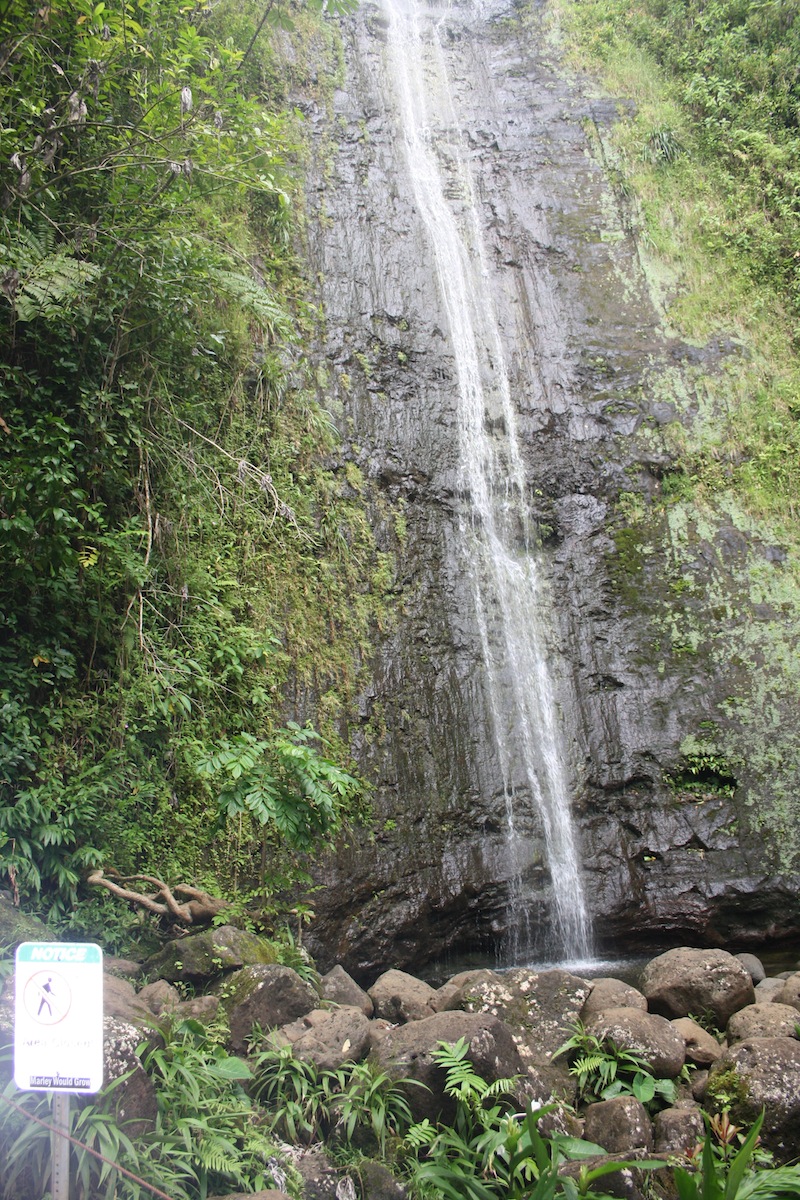
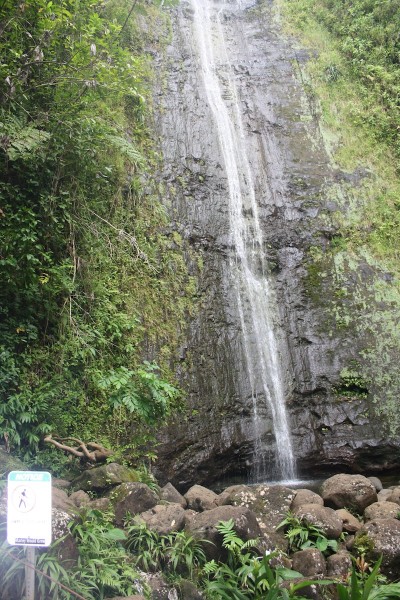
But I continue on, not wanting to give up, and wanting to see this neat, tall waterfall that is the second most popular hike on Oahu. We have to meet Bitter’s grandmother for dinner in a few hours. Surely she won’t mind of I show up with muddy shoes, muddy pants, and dripping enough sweat I’ll look like I went for a dip in the ocean? Maybe I can dip under the waterfall when I get up there. I’ve already swam in one waterfall this week. From a distance I become concerned. Concerned that all I see is a small sliver of water in an awful lot of green. A TrickleBitter is starting to look dehydrated, and is having second thoughts about whether the pain is worth the reward, and decides to hang back and let me continue ahead. I’ve been told it’s been a pretty dry year, but it’s rain forest, right? The ground is wet and muddy! Well, down in the valley maybe it’s raining, but I’m not sure there’s enough rain up high to really get the falls moving. Sure enough, I am disappointed when I get there. My tall, gushing waterfall is so anemic, I think if I climbed to the top and peed in the stream that feeds it, I’d probably double its size. But such is Manoa Falls Tricklenature. I wouldn’t mind so much if the book had prepared me for a muddy, wet, humid, and mosquito infested hike, but it didn’t. I guess the real lesson is don’t trust guide books. And oh yeah, the rain forest sucks. There’s nothing fun, even prepared, hiking in saturated air at 100% relative humidity. I guess that hippy eco tour of Costa Rica I’ve never wanted to take is going to be out then.
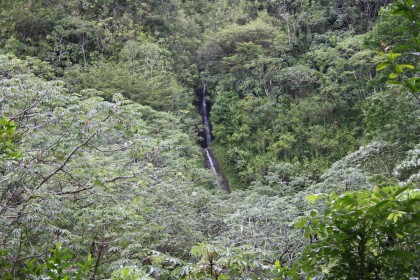
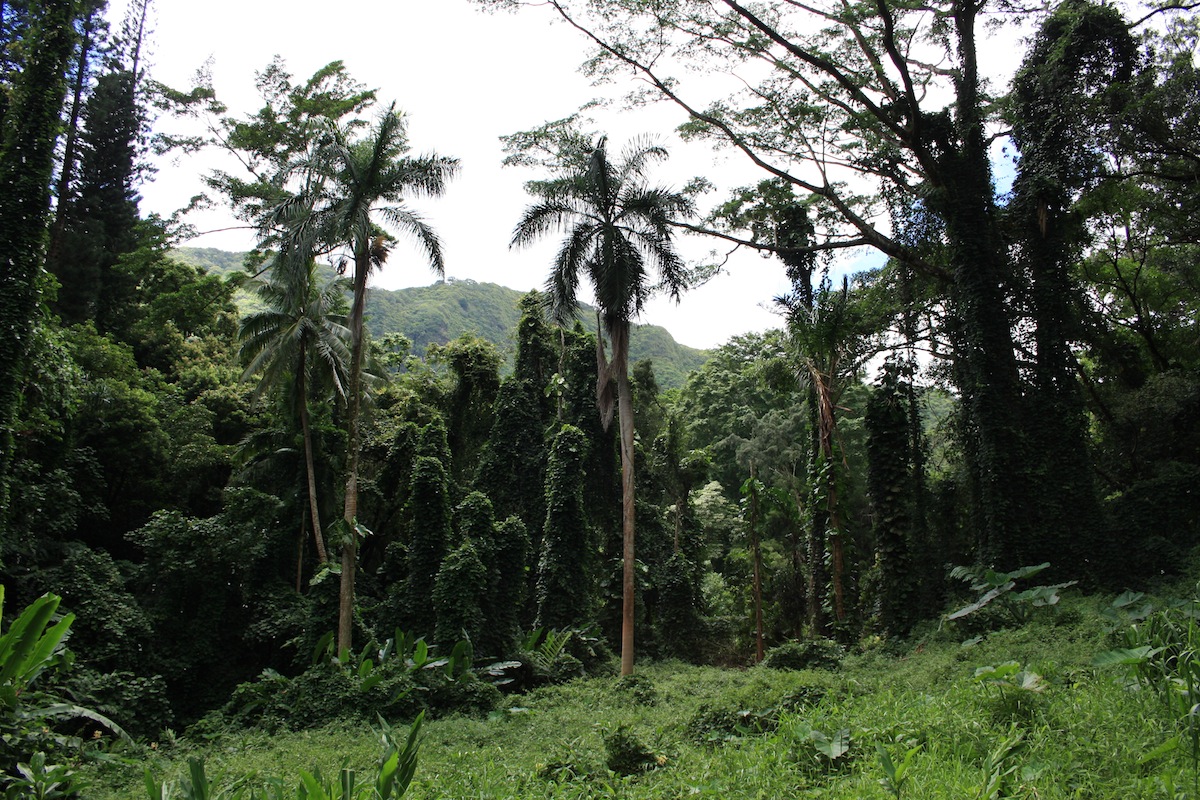
Tomorrow is our last day on Oahu. Monday, early, we fly over to the Big Island (Hawaii), and change our itinerary from Lost tours, glider flying, snorkeling, hiking, and historical Hawaii stuff, to astronomy, vulcanology, and coffee farming. It should be an interesting change of pace. It also should be an interesting change of scale. There’s a reason they call it “The Big Island.” Oahu is small. You can generally get anywhere on the island within an hour, not accounting for bad traffic sometimes in Honolulu. But the Big Island would take the better part of a day to circumnavigate. The population density on the Big Island is also much lower, which, after a week in or around Honolulu, I’m looking forward to. Based on lava forecasts, it doesn’t appear I’ll be able to live my dream of poking lava with a stick, but I have to save something for next time. For now I’m happy to be headed to Pele’s playground.

I Am Starting To Grade The First Weekly Question…And I Am Very Pleased

Some years back, Idaho imposed a senior project requirement on all the high schools in the state, at least partly to make sure that graduating seniors could actually write.  I think it works.  In 2003, I was utterly floored at how few of the upper division history majors in my Constitutional History class could actually write at college level.  I had a student turn in a paper where 1/3 of the sentences–were not.  I had students tell me that this was only the second research paper that they had ever written–and did it show.  I would say that only five of the twenty-five research papers that I received that semester were what I would expect of upper division college students.

By comparison, these essays from the freshmen in my U. S. History class at College of Western Idaho (a community college) are gratifying.  They aren’t perfect, of course.  But so far, of the ones that I have graded, many are good and several are actually quite good.  Most students at least know how to write competent sentences; some students are combining competent sentences into well-structured essays.  A few students have not achieved sentence structure competency (or competency in capitalization, or punctuation), but nonetheless, have well-structured essays.

There is room for improvement for all of them, so far.  Still, many of them are starting with what would have been considered high school level writing skills when I graduated from Santa Monica High in 1974.

A Reminder That Rapacious Lawyers Are Not a New Problem

I was reading through Hening’s Statutes at Large; BEING A COLLECTION OF ALL THE LAWS OF VIRGINIA FROM THE FIRST SESSION OF THE LEGISLATURE IN THE YEAR 1619 in preparation for class yesterday, and I ran into this gem that reminds us that rapacious lawyers are not a new problem.

BE it also enacted, for the better regulating of attorneys and the great fees exacted by them, that it shall not be lawfull for any attorney to plead causes on behalfe of another without license or permission first had and obtained from the court where he pleadeth, Neither shall it be lawfull for any attorney to have license for mor courts then from the quarter court and one county court, and that they likewise be sworne in the said courts where they are so licensed, And it is further enacted that no attorneys plead in any county court shall demand or receive either for drawing petition, declaration or answer and for his ffee of pleading the cause of his client above the quantitie of 20 lb. of tobaccoe or the value thereof, nor that at any pleading in the quarter court shall demand and receive either for drawing petition, declaration or answer and for his ffee of pleading the cause of his cliant above the quantity or 50 lb. of tobaccoe or the value thereof, [Hening, Statutes at Large, 1:275, ch. 61, March 1642/3]

This doesn’t mean that everything that they did was fine back then.  The 1620s statutes are awash in mandatory church attendance laws, and the 1630s statutes are various laws limiting the amount of tobacco you could plant, as a way to keep prices up.  Still, it is a reminder that some problems are not new.

By the way, if you visit that collection–someone did a lot of work to transcribe (not just scan) Hening’s Statutes at Large, primarily for the benefit of genealogists.  It’s just an amazing resource for historians.

Bottled Water

The standard out here seems to be Hawaiian Isles, 100% Hawaiian Purified Water. Now, I usually drink bottled water at home, because Philly water tastes like they stick a dead fish in the pipe ever couple of hundred gallons. Now don’t get me wrong, Hawaiian Isles is good water, but here’s the description on the bottle:

From the rain clouds in tropical skies to the tops of island mountains, then filtered through layers of volcanic rock to a natural aquifer deep underground, Hawaiian Isles water is purified naturally on its journey to you…

It then goes on to describe the high tech filtering they do to the water. But lets go down the list of what water is going to do on Oahu: Start in clouds? Check. Fall onto volcanic mountains? Check. Seep through porous volcanic rock to the water table? Check. Folks, I’m pretty sure this successfully describes the journey the Honolulu municipal water supply makes. How much would you bet?

Dinosaurs That Don’t Evolve, Die

Part of the rationalization that the stinker in chief at the Las Vegas Review-Journal uses for the Righthaven lawsuits is that newspapers are being driven out of business by bloggers infringing copyrighted newspaper articles.  While I agree that infringement is wrong (although usually unintentional), it is not particularly plausible that this is the source of the problems that newspapers are having, for a number of reasons:

1. It is true that if you copy too much text from a newspaper, it may discourage some readers from clicking through to read the article.  On the other hand, how many readers click through to read the article, if it was copied in full, anyway?  I know that I often find myself clicking through, even when a blogger has copied a substantial amount of the article–to see if they have quoted the article out of context.

2. Traffic that bloggers get because of an alleged copyright infringement are a tiny fraction of the hits that a newspaper receives as a result of Google searches, links from Drudge Report, or even clickthroughs caused by bloggers linking to an article on the newspaper’s website.  The problem that newspapers are having isn’t because of bloggers, but the collapse of traditional dead trees publishing.  Bloggers linking to newspapers are almost certainly a net gain for newspapers–unless, of course, you decide to turn an innocent, one-time mistake (as my co-blogger on The Armed Citizen made) into a $75,000 suit.  At that point, the negative publicity and aggressive delinking from such newspapers is almost certainly going to turn such a lawsuit campaign into a net loss.

Yes, a newspaper deserves to get all the ad volume it would enjoy if everyone clicked through, instead of reading the article elsewhere–but there are polite, sensible ways to solve the problem, and there are impolite, irrational ways to do so.  My guess is that the editor of the Review-Journal wouldn’t trim his fingernails with a chainsaw, or stop his car by slamming it into brick wall.  There are less drastic solutions–which nearly all newspaper organizations use, such as an email or letter demanding that you take down an infringement.  (At least, I’ve read that this is the case; I’ve never had a news organization make such a request.)

In nearly all cases, bloggers have made an innocent mistake, through ignorance of the law (which is very easy, since fair use law is extraordinarily vague), or excess enthusiasm for a particularly well-written article.  A blogger who ignores a request, or who keeps infringing again and again–I can see that a lawsuit might make sense there.  But to go directly from one article infringing to a $75,000 lawsuit is just crazy.

Anyway, all that to point to this article at Nieman Journalism Lab, which points to an innovative solution to the dinosaur news media problem:

It is a head-turner, which seems to be, at first, an only-in-Utah story. The Deseret Morning News, KSL TV, and KSL Radio, all owned by one company, the Deseret Management Co., a for-profit arm of the Church of Latter-Day Saints, are combining operations.

Instead of each organization sending a reporter to the statehouse to cover an event, one reporter covers it.  The difference between radio, television, and newspaper is evaporating in the digital age.  The Review-Journal is trying to use the tyrannosaurus rex approach of ferocity to stave off the inevitable end of the Age of Dinosaurs.  (Unlike the movie Jurassic Park–where the T. rex at least has the good taste to eat the lawyer.)

Hello, All!

I’m helping to fill in on Snowflakes in Hell while someone insists on vacationing in Hawai’i.  For those of you who don’t know me: I am Clayton Cramer.  I normally blog over at my own blog, so you will likely see some overlap while I filling in.

It took a while for me to get started on guestblogging because I was:

1. Finishing a State & Local Government class in the summer term at one technical institute.

2. Starting first semester U.S. History class in the fall term at College of Western Idaho.

The overlap of a week was a bit much.

Clear some room and dig out some Combat Results Tables in Fiddler’s Green

Charles Roberts, founder of Avalon Hill, passed away over the weekend. He didn’t invent the tabletop wargame, but without AH, wargame and role-playing games as we know them might not exist. Shame the obit above barely touches on the seminal role of both Charles Roberts and Avalon Hill in the gaming industry.