Most Significant Loss to Date

I believe that Heller II or Heller v. DC is our most significant loss in court to date. It’s being picked up quite heavily by the media, and our opponents are justifiably celebrating. Understand that this is not a District Court loss. Those have become par for the course in Second Amendment cases. This is a loss of an entire federal circuit, and arguably the most important federal circuit. Gene Hoffman had a comment that I think is worth highlighting:

I really wish that people didn’t try to boil the ocean. Any one of the three issues should have had a full and separate case and be brought in the right order…

I think he’s absolutely correct here, and unfortunately this is not the only NRA-backed case that’s flawed in this manner. Benson, challenging the entire kitchen sink of Chicago regulation is similarly flawed. I would also argue that Dick Heller, while a good plaintiff for the original case challenging handgun possession, was a poor choice for going after restrictions on semi-automatic rifles. I believe NRA needs to start being a lot more careful about the battles it’s choosing to fight in Court.

While I believe the case in regards to purchase by 18-21 year olds has merit, I question of the wisdom of going after carry by 18-21 year olds at the same time. Do we really want the courts to understand the full extent of the can of worms they could be opening? We need strong rulings, starting out. What we don’t need are courts getting scared by extraneous issues we can get more easily when the case law looks more solid. Using this example, if you get courts to say 18-21 year olds have Second Amendment rights that can’t be impermissibly infringed, and you can get courts to say that there’s a right to carry, carry for 18-21 year olds flows naturally for that. It’s just not necessary, in my opinion, to bring that suit.

By the same token, I believe pursuing an assault weapons case at this point was highly premature, and said so last year when this failed in District Court. Heller II would have done far better to focus narrowly on the most onerous of DC’s requirements when it comes to the exercise of the core right. I really hope NRA re-examines its legal strategy. At the risk of hurting some feelings at NRA HQ, SAF has a far more coherent and concise legal strategy.

But that said, the greatest thing NRA will do for us, which is absolutely essential, and something SAF cannot do, is to create a political climate where ruling against the Second Amendment is career suicide for judges looking to advance on the bench. We have to get the Second Amendment community obsessed about what federal judges think about the Second Amendment. That is, unfortunately, a tall order. But it is necessary.

It is my honest opinion that if we do not take back the White House in 2012, we’re going to end up with a very weak and nearly meaningless Second Amendment right, that will never mean anything beyond being able to have a handgun in the home, with any manner of obstacles and frustrations being thrown in the way of that being perfectly acceptable by the federal courts. If we can be victorious in 2012, this ruling, as much of a setback as it is, will likely only be a speed bump on the way to turning the Heller II dissent into prevailing legal opinion.

A Little Touchy Are We?

Instapundit is reporting that CBS reporter Sharyl Attkisson was screamed at by the White House over her reporting on Fast and Furious:

 They will tell you that I’m the only reporter–as they told me–that is not reasonable. They say the Washington Post is reasonable, the LA Times is reasonable, the New York Times is reasonable, I’m the only one who thinks this is a story, and they think I’m unfair and biased by pursuing it.

I guess they want her in the tank along with all the other papers mentioned. It’s worth noting that at one time, reporters felt it was their responsibility to hold the government and its officials accountable. I guess that time has passed.

Ms. Attkisson better watch it, or she’ll get the Chicago treatment. I hope she’s been meticulous and scrupulous about her tax returns.

UPDATE: House GOP is calling for a special prosecutor to investigate Eric Holder. This is coming from Judiciary. Maybe this is why the White House and DOJ are so testy.

Heller II: The Dissent

Say what you will about how much George W. Bush sucked for gun rights, and a lot of people make the case, but his judges seem to be the ones who take the Second Amendment seriously. It’s worth noting that Judge Sykes, who wrote the opinion in Ezell, was a Bush nominee. The other two judges were put on the Court by Bush the Elder, and Ronald Reagan. Reagan’s appointments to the Court seem to be more mixed. But Judge Kavanaugh, put on the bench by George W. Bush, was the dissenting judge in this case. From the opinion:

In my judgment, both D.C.’s ban on semi-automatic rifles and its gun registration requirement are unconstitutional under Heller.

In Heller, the Supreme Court held that handguns – the vast majority of which today are semi-automatic – are constitutionally protected because they have not traditionally been banned and are in common use by law-abiding citizens. There is no meaningful or persuasive constitutional distinction between semi-automatic handguns and semi- automatic rifles. Semi-automatic rifles, like semi-automatic handguns, have not traditionally been banned and are in common use by law-abiding citizens for self-defense in the home, hunting, and other lawful uses. Moreover, semi- automatic handguns are used in connection with violent crimes far more than semi-automatic rifles are. It follows from Heller’s protection of semi-automatic handguns that semi-automatic rifles are also constitutionally protected and that D.C.’s ban on them is unconstitutional. (By contrast, fully automatic weapons, also known as machine guns, have traditionally been banned and may continue to be banned after Heller.)1

You can see the importance of the 2012 elections in whether we’re going to have a strong Second Amendment. The more people Obama puts on the federal courts, the more rulings like this we’re going to get, and eventually, without defense from the Supreme Court, the Second Amendment will slowly be interpreted to be an individual right that is virtually devoid of meaning.

Judge Kavanaugh’s dissent is very interesting, because he rejects an approach to the Second Amendment based on levels of scrutiny, and instead adopts one based on text and traditions, as described here:

So the major difference between applying the Heller history- and tradition-based approach and applying one of the forms of scrutiny is not necessarily the number of gun regulations that will pass muster. Instead, it is that the Heller test will be more determinate and “much less subjective” because “it depends upon a body of evidence susceptible of reasoned analysis rather than a variety of vague ethico- political First Principles whose combined conclusion can be found to point in any direction the judges favor.” McDonald, 130 S. Ct. at 3058 (Scalia, J., concurring).

Which has been precisely the behavior we’ve seen from federal judges, especially on lower courts.

The majority opinion here applies intermediate scrutiny and contends that intermediate scrutiny is consistent with Heller and McDonald. The majority opinion employs history and tradition only as a threshold screen to determine whether the law in question implicates the individual right; if so, the majority opinion then subjects the individual right to balancing under the intermediate scrutiny test. As explained above, I disagree with that approach. I read Heller and McDonald as setting forth a test based wholly on text, history, and tradition. Deeper examination of the two Supreme Court opinions – and, in particular, how the Court’s opinions responded to the dissents in the two cases – buttresses my conclusion.

I think this is a very interesting dissent, and I haven’t seen this approach taken before, but after reading the whole thing, I think it’s entirely consistent with what the Court was trying to say in Heller and McDonald.

The Supreme Court struck down D.C.’s handgun ban because handguns have not traditionally been banned and are in common use by law- abiding citizens, not because the ban failed to serve an important government interest and thus failed the intermediate scrutiny test. And the Court endorsed certain gun laws because they were rooted in history and tradition, not because they passed the intermediate scrutiny test.

One final aside about the appropriate test to apply: Even if it were appropriate to apply one of the levels of scrutiny after Heller, surely it would be strict scrutiny rather than the intermediate scrutiny test adopted by the majority opinion here. Heller ruled that the right to possess guns is a core enumerated constitutional right and rejected Justice Breyer’s suggested Turner Broadcasting intermediate scrutiny approach. And McDonald later held that “the right to keep and bear arms” is “among those fundamental rights necessary to our system of ordered liberty.”

If we want to see dissenting opinions like this become majority opinions, we have to get Obama out in 2012. I don’t care that smart ass half-wits like Jon Stewart make fun of us for trying to paint Obama as anti-gun. The people he’s putting on the Court will try to read the Second Amendment out of the Constitution, and that’s all that honestly matters.

It is especially inappropriate for the majority opinion here to apply intermediate scrutiny rather than strict scrutiny to D.C.’s ban on semi-automatic rifles. No court of appeals decision since Heller has applied intermediate scrutiny to a ban on a class of arms that have not traditionally been banned and are in common use. A ban on a class of arms is not an “incidental” regulation. It is equivalent to a ban on a category of speech. Such restrictions on core enumerated constitutional protections are not subjected to mere intermediate scrutiny review. The majority opinion here is in uncharted territory in suggesting that intermediate scrutiny can apply to an outright ban on possession of a class of weapons that have not traditionally been banned.

Indeed.

Heller II Loses in DC Circuit, Mostly

The challenge was on DC’s gun laws as they stand post-Heller. They have been upheld in part and remanded in part:

We hold the District had the authority under D.C. law to promulgate the challenged gun laws, and we uphold as constitutional the prohibitions of assault weapons and of large-capacity magazines and some of the registration requirements. We remand the other registration requirements to the district court for further proceedings because the record is insufficient to inform our resolution of the important constitutional issues presented.

I hope in this case that Heller II stops here, because this is not a good case to move forward, and it’s already done enough damage. Challenging the “assault weapons” provisions of DC’s law was highly premature, especially considering we’re likely to remedy that through Congressional action if we can flip the Senate and the White House.

The record supports the view that basic registration of handguns is deeply enough rooted in our history to support the presumption that a registration requirement is constitutional.

I’m not optimistic that registration requirements will be held unconstitutional. It’s hard to imagine a federal judiciary that doesn’t really like the Second Amendment to rule otherwise. If you look at the core right, as the courts have defined it, it’s difficult to argue how registration infringes on it in a substantial way. Nonetheless the Appeals Court seems to be skeptical about requiring it for long guns.

But the Appeals Court seems to be hanging onto the “longstanding” aspect of the original Heller ruling, and seem to be applying a test that if a law is longstanding, it must therefore be constitutional. This strikes me as extraordinarily weak reasoning, although it was exceedingly weak language from the Court, in my opinion. The Appeals Court’s opinion here seems to be based on the fact that the Sullivan Act is longstanding, and therefore a registration scheme, as applied to pistols, is constitutional.

As between strict and intermediate scrutiny, we conclude the latter is the more appropriate standard for review of gun registration laws.

Couldn’t have seen that coming. Has any court decided that using strict scrutiny is appropriate for anything related to the Second Amendment? Not that I’ve seen. They always find a reason it’s not appropriate. But on to the assault weapons issue, since that is the most curious. There is one bright spot. The Appeals Court found they are in common use:

We think it clear enough in the record that semi- automatic rifles and magazines holding more than ten rounds are indeed in “common use,” as the plaintiffs contend. Approximately 1.6 million AR-15s alone have been manufactured since 1986, and in 2007 this one popular model accounted for 5.5 percent of all firearms, and 14.4 percent of all rifles, produced in the U.S. for the domestic market. As for magazines, fully 18 percent of all firearms owned by civilians in 1994 were equipped with magazines holding more than ten rounds, and approximately 4.7 million more such magazines were imported into the United States between 1995 and 2000. There may well be some capacity above which magazines are not in common use but, if so, the record is devoid of evidence as to what that capacity is; in any event, that capacity surely is not ten.

But then proceeded to argue that they were not protected, and restricting them is perfectly constitutional:

Nor does the ban on certain semi-automatic rifles prevent a person from keeping a suitable and commonly used weapon for protection in the home or for hunting, whether a handgun or a non- automatic long gun.

They adopted the substitution principle, which was rejected when D.C. made that argument in the original Heller. Basically, because you have access to some firearms in common use, banning other firearms in common use is perfectly OK because of substitution.

Although we cannot be confident the prohibitions impinge at all upon the core right protected by the Second Amendment, we are reasonably certain the prohibitions do not impose a substantial burden upon that right. As the District points out, the plaintiffs present hardly any evidence that semi-automatic rifles and magazines holding more than ten rounds are well-suited to or preferred for the purpose of self- defense or sport.

Magazines don’t fare any better:

The Siebel testimony moreover supports the District’s claim that high-capacity magazines are dangerous in self-defense situations because “the tendency is for defenders to keep firing until all bullets have been expended, which poses grave risks to others in the household, passersby, and bystanders.”

So they don’t let their police carry them, do they? NRA now has a mission. It needs to overturn the D.C. gun laws through Congressional action, and I think it would be of great benefit if a quip could be added to the bill citing Congress finds this ruling in error. It’s worth noting that none one of the judges on this panel were was the same as those who decided  lone dissenter in the Parker (which then become Heller) case.

I strongly believe the Second Amendment needs to become a litmus test for federal judges. We want the most ambitious of the federal bench fearful to rule against us for the possibility that will be used to prevent advancement to a higher court.

I should note the Court devoted a significant part of their opinion in this case to addressing the dissenting judge in this case. That must mean the dissent is pretty good. We’ll take a look at that later.

Holder Knew Sooner than He Testified

From CBS News:

New documents obtained by CBS News show Attorney General Eric Holder was sent briefings on the controversial Fast and Furious operation as far back as July 2010. That directly contradicts his statement to Congress.

Of course, the White House is claiming they never knew this operation was about letting guns walk. Holder is also claiming he didn’t know details. The documents released by the White House this weekend would appear to show that if the White House wasn’t aware guns were being walked, they are pretty stupid:

As CBS News has reported, the email exchanges between Newell and O’Reilly lasted for more than a month. Among the documents produced is an email Newell sent O’Reilly with an “arrow chart reflecting the ultimate destination of firearms we intercepted and/or where the guns ended up.”

It was mostly the latter since, as we have documented, ATF agents were ordered by superiors not to interdict the weapons traffic, surveillance would be called off, and requested interdiction teams were not sent to arrest the traffickers when opportunities to do so arose. Most of the guns were allowed to “walk” into Mexico.

I’m wondering if Congress has enough now to at least impeach Holder.

Oregon Campus Carry Already Having Positive Effects

You may have heard that the Court of Appeals in Oregon threw out the campus carry bans because the were preempted by state law. They thew the rule out on preemption grounds and did not reach whether the Second Amendment was implicated. You have to wonder if not wanting to dive into Second Amendment analysis might have been a small motivation for ruling in favor of the plaintiffs.

Either way, I’m pleased to report that the ruling is having a positive effect already. If you could take hysterics, and harness it as an energy source, our opponents could have us energy independent inside a couple of weeks.

Gunnie Goodies

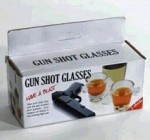
People like to mix guns and drinks. By drinks, I don’t mean the alcoholic kind. And by guns, I don’t mean the shooty kind. I couldn’t help but be amused by all these things that popped up on a random Amazon search the other day.

What amuses me is that this stuff is just miscellaneous pop culture crap. This isn’t stuff targeted at the “gun culture.” Yet, somehow there are people on the other side who actually believe they can rid the world of guns and get rid of demand for guns.

UPDATE: This post became significantly more relevant with the discovery that tomorrow is National Vodka Day.

Careful What You Wish For

Katie Pavlich reports on a rumor that the DOJ is considering elimination of ATF. As I’ve stated previously on here, I think it would be a bad idea. The country’s gun laws are not going away, and someone is going to be charged with enforcing them. That agency is likely to be the FBI. While the FBI would certainly do the enforcement part far more competently, you’d be giving the FBI an incentive to lobby Congress for more gun laws.

The problem with that is that people in Washington have a high degree of respect for the FBI, and they are listened to. ATF is the bastard step-child of federal law enforcement, and Congress and the other D.C. powers that be don’t really take them too seriously. It’s also worth noting, because of the FBI’s other missions, you’re not really going to have much luck threatening the FBI’s funding in order to keep it under control.

Given all that, I’m in favor of keeping ATF in place, and replacing its leadership, including the guys at the very top in 2012. Getting rid of ATF is a feel-good measure. Strategically, I think it would be a disaster to give FBI and incentive to lobby Congress for more gun laws, and be able to raise the specter of terrorism every time we try to threaten their funding in Congress for misbehavior.